Home
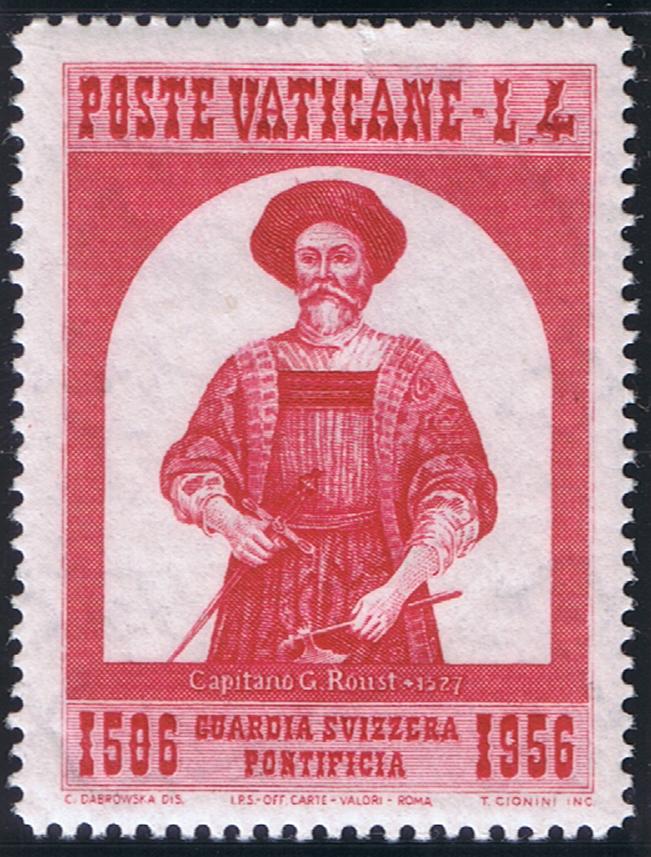


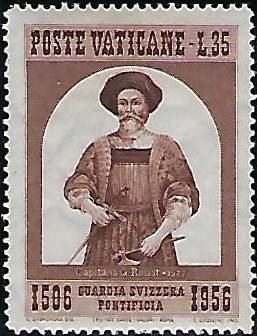
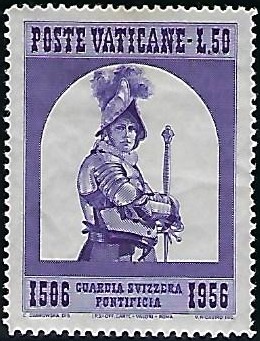

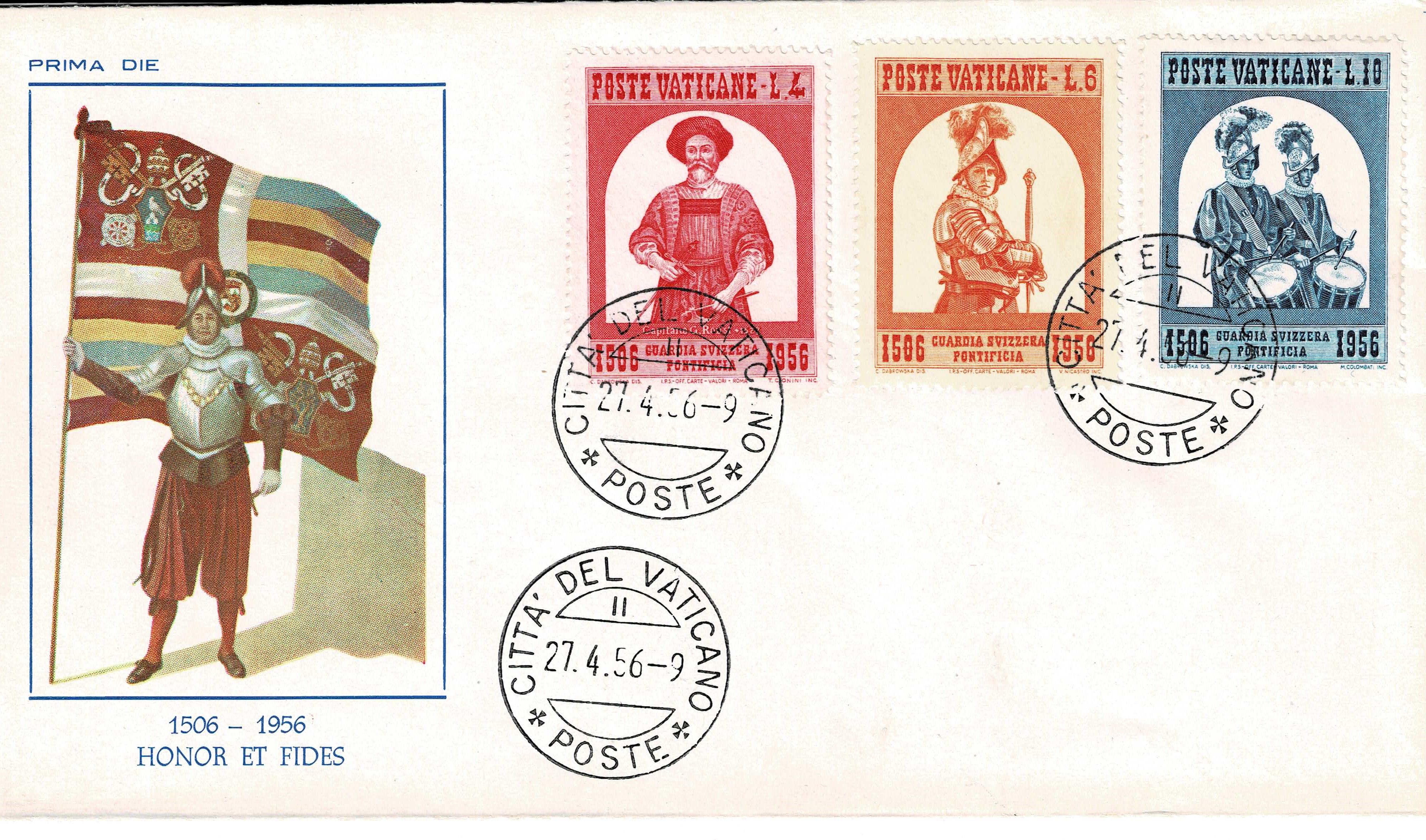
Since the Middle Ages, the Papacy has possessed certain temporal powers as well as supreme spiritual authority. From the eighth to the nineteenth centuries, it maintained a civil administration to govern the important central Italian region known as the Papal States. During much of this period, the Papal States were vulnerable to possible invasion by neighboring European powers. Therefore, the Papacy also maintained its own armed forces to preserve its political independence. This temporal role of the Popes was all but ended by the occupation of Rome in 1870. However, certain Papal military units survived to perform ceremonial and security functions within the only remnant of the Papal States, Vatican City. These include the Swiss Guard/ the Palatine Guard, the Noble Guard, and the Gendarmery. In 1956, the Vatican issued a set of six stamps to honor the most famous of its armed forces, the Swiss Guard (see Scott's #203-208). From the fifteenth to the eighteenth centuries it was a common practice among European rulers to include Swiss regiments in their armies. These regiments were famous for their discipline and their devotion to duty. In 1505, the Swiss Cardinal Schinner persuaded Pope Julius II to form a personal bodyguard of Swiss troops. That same year, the Pope made a treaty with the Swiss cantons of Zurich and Lucerne, in which the two cantons agreed to supply a Guard of 250 men. In 1506, the first Swiss troops arrived in Rome. Soon after its establishment, the Swiss Guard dramatically proved its loyalty to the Pope. On May 6, 1527, Rome was stormed by the army of the Holy Roman Emperor Charles V. The imperial Army was composed mainly of German mercenaries who had not been paid in months, so they proceeded to pillage and loot the city. Pope Clement VII was forced to flee for his life. While he made his escape, the Swiss Guard fought a valiant delaying action in front of St. Peter's Basilica. Here, 147 Swiss led by Captain Gaspare Roust (see Scott 203-206 above) stood their ground against a horde of hostile Imperial troops pour. ing into St. Peter's Square. Roust and his men all lost their lives, but not until they had slain over 800 of their attackers. Meanwhile, 42 other Swiss escorted the Pope to safety in the nearby Castel Sant'Angelo. This heroic stand firmly established the proud reputation of the Papal Swiss Guard. Later in this article, we shall examine the Swiss Guard as it exists today. On December 14, 1850, Pope Pius IX combined two already existing militia units to form the Palatine Guard. While the Swiss Guard has always been a force of full-time paid professional soldiers, the Palatine Guard consisted of ordinary Roman citizens who freely volunteered their services to the Pope. They received only a small stipend for their distinctive uniforms, which included a shako Witt a crimson plume, blue trousers, and a tunic trimmed in crimson and gold. They also wore white leather sword and cartridge belts, and were armed with rifles and nickel daggers. Their main function was to stand guard during ceremonies at the Vatican. During World War II they were summoned to full-time duty, and helped to protect Vatican property from sabotage and other acts of irreverence. On November 5, 1943, a small plane dropped four bombs on the Vatican. One of the bombs demolished the mosaic studio near the railway station. Although two Palatine Guardsmen were stationed' near the damaged area, they did not abandon their posts. After the war, the Guard returned to its part-time ceremonial duties. In 1950, the Vatican issued a set of three stamps to commemorate the centennial of the Palatine Guard (Scott's 140-142). These stamps show the Guard marching in front of St. Peter's Basilica. Two other important Papal units were the Noble Guard and the Gendarmerie. In 1801, Pope Pius VII established the Noble Guard as a special mounted bodyguard. All Guardsmen held titles of nobility as well as officers' rank. After World War II they ceased to be a mounted unit. From then on the main function of the Noble Guard was to provide music for Papal processions. The Gendarmery was the police force of Vatican City. All gendarmes served previously in the Italian Army, and many of them were former Carabinieri (Italian National Police) as well. They wore colorful Napoleonic-style uniforms. In addition to maintaining general law and order, they turned away improperly dressed persons. trying to enter St. Peter's Basilica. In September of 2970, Pope Paul VI disbanded the Palatine Guard, the Noble Guard, and the Gendarmery. In explaining his action, the Pope said that these units "... though deserving of all praise, no longer correspond to the needs for which they were founded." The Vatican has since established a modern security force, the Servizio di Vioilanza. It consists of plain-clothed personnel who carefully observe all visitors to the Vatican. However, the most important Vatican security force is still the Swiss Guard. Today the Guard numbers about 100 men commanded by a colonel. All Guardsmen have previous military experience as members of the Swiss Army. Near the end of his tour of duty, a Swiss soldier becomes eligible to join the Guard if he meets certain requirements. He must be a Catholic, of good character, single, and at least five feet, 81/2 inches tall. New recruits sign on for a minimum enlistment of three years, and begin with a colorful swearing-in ceremony. This usually takes place on May 6th in the Courtyard of St. Damasus. Each new recruit grasps the Guard banner with his left hand, and raises two fingers and the thumb of his right hand (symbolizing the Trinity). Like all his predecessors, he then swears to lay down his life for the Pope, if necessary. Guardsmen are usually armed with medieval halberds and broadswords. However, they are also trained in the use of Swiss Army rifles and submachine guns. They keep these modern weapons close by when on sentry duty. Since gunfire is forbidden on Vatican grounds, they must go outside Rome for rifle practice. All Guards, are also trained in hand-to-hand combat. They have two basic uniforms, which normally include simple black berets rather than helmets. Their red, yellow, and blue formal uniform is said to have been designed by Michelangelo. This uniform is worn regularly by Swiss Guards on sentry duty at the Arch of the Bells (to the left of St. Peter's Basilica) and at the Bronze Gate (entrance to the Apostolic Palace Place). They also have a less formal steel blue uniform. Their armor is cleaned and polished daily, but is worn only on special occasions. Swiss Guards are found on sentry duty at all entrances to the Vatican. They are also stationed at all doors leading to the Pope's private chambers. The two Guardsmen at the entrance to the Papal Study refuse admittance to all but a select few. During Papal Audiences, they check all those entering St. Peter's Square to make sure they have the required tickets. The Swiss Guard and the Servizio work together to maintain order UUFFKg audiences. The Swiss Guards are among the few actual residents of Vatican City. Their barracks are found just inside St. Anne's Gate, not far from the Central Post Office. Here they have their own chapel, canteen, tailor, and barber. Officers, who are allowed to marry, live in private apartments with their families. It is a good life, and many Guards re-enlist. The Papacy was served by four special military units from 1929 to 1970. Two of these, the Palatine Guard and the Noble Guard, were mainly ceremonial units, while the Gendarmery was the Vatican police force. As the ceremonial features of the Papacy were reduced, these three units became obsolete. However, the Swiss Guard has survived to continue its long proud tradition of protecting the Pope. This article originally appeared in Vatican Notes in November, 1982, and can be accessed by clicking on the reference below. Very minor edits have been made to the original presentation. REFERENCE: BIBLIOGRAPHY: Technical Details: Scott Catalogue - 203 - 208 Date Issued - 27 April 1956 Face Value - 4 l, 6 l, 10 l, €1.25, 35 l, 50 l, 60 l Perforations - 13 Printer - The Italian State Printing Works |
| (From Vatican Notes Volume 31, Number 3, November 1982, Pages 5-7) |