Home
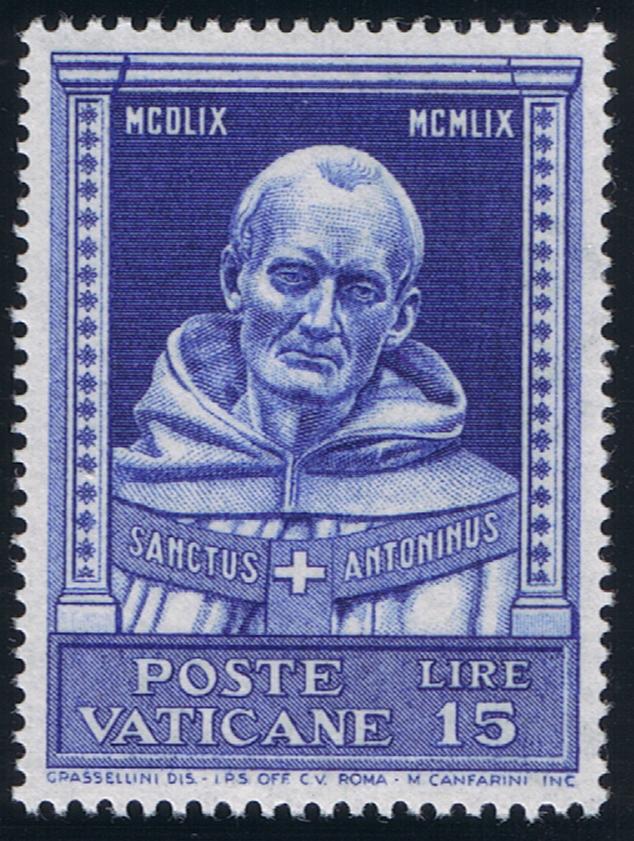
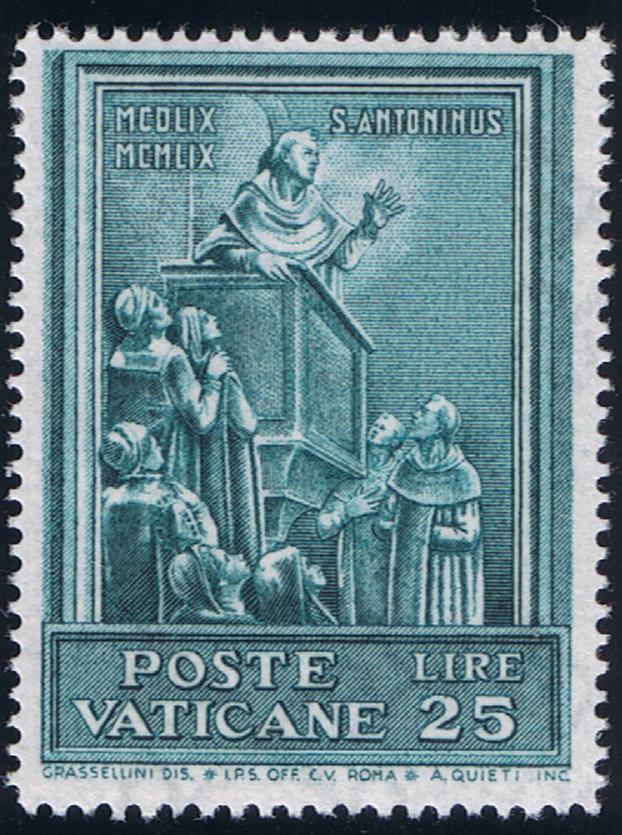
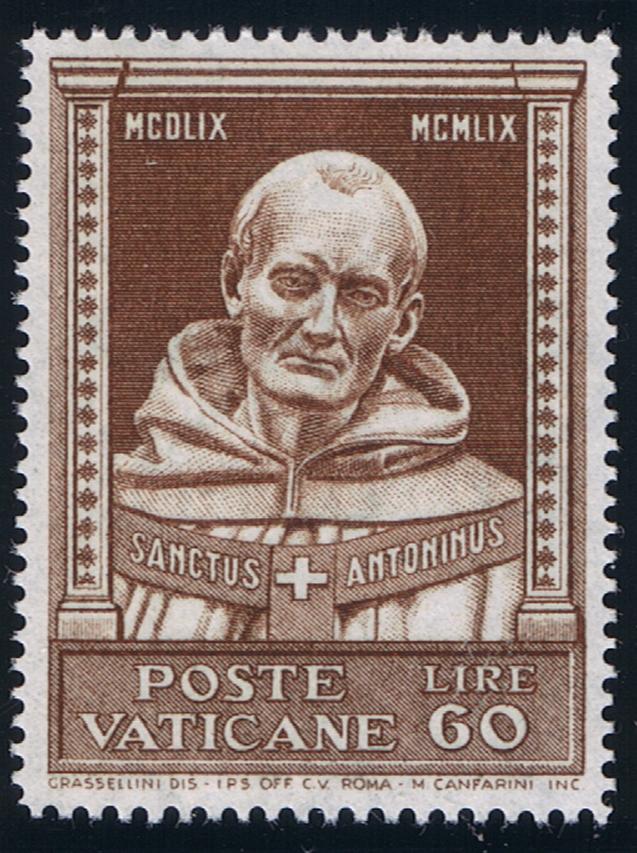

Vatican City recognized St. Antonino (Antoninus) [Antonin Piarizei,1389-14591] on the 500th anniversary of his death through a set of four stamps issued 29 February 1960 (Scott 269-272). A large number of first-day covers were issued (which was typical of this era). The stamps were designed by A. Grassellini. The £15 and £60 values (Scott 269, 271) were engraved by M. Canfarini, based upon a bust of the saint by Giovanni Dupre (d. 1882) in the Uffizi Gallery of Florence. The £25 and £110 values (Scott 270, 272) were engraved by A. Quieti and are based upon a brass relief of Antonino by Pagno di Lapo Portgioni at the Chiesa di San Marco in Florence. A total of 625,700 sets were printed by the Italian State Printers in Rome. St. Antonino's historical context are the years of the Great Schism of the Western Church (1378-1417), the Conciliar Movement (first half of the 15th century), and the fall of Constantinople to the Ottoman Turks (1453). St. Antonino is known as a reformer of monasteries, an Archbishop of Florence, and a writer of theology and historical works. He entered the Dominican Order in 1405. His abilities were recognized early and he undertook administration and reform duties at other Dominican monasteries in Italy. From 1433-1435 he was Vicar-General of the Dominican Congregation. He established St. Mark's Convent in Florence in 1436, known for its monastic cells decorated by Fr Angelico or his students. In 1446, Antoninus was consecrated Archbishop of Florence by Pope Eugene IV, a position he held until his death. Antonino was known for his life of poverty, even as archbishop, as well as his generosity for the poor. Small in stature, he traveled through his diocese on foot or by mule, visiting all parishes, and preaching along the way. He helped alleviate periodic outbreaks of the plague. In his later years, he saved as ambassador from Florence to the Holy See. Antonino served as papal theologian during 1439-1445, the later years of the Council of Florence (Basel-Ferrara-Florence, 1431-1449). He wrote theological works on morality and texts used by confessors. He also wrote a history of the world from creation to the 14th century. Pope Pius II conducted his funeral, and praised Antonino as one who had "conquered avarice and pride, was outstandingly temperate in every way, and was a brilliant theologian and popular preacher". David Farmer writes that at his death his possessions consisted of "cheap furniture" and a mule. St. Antonino was canonized in 1523 by Pope Adrian VI and his feast day is now 2 May, the date of his death. Reference: David Farmer, Oxford Dictionary of Saints, 5th edition, (Oxford: 2015). |
| (Source: James C. Hamilton, Vatican Notes, Volume 62, Issue 360, page 16-17, 2014) |