Home
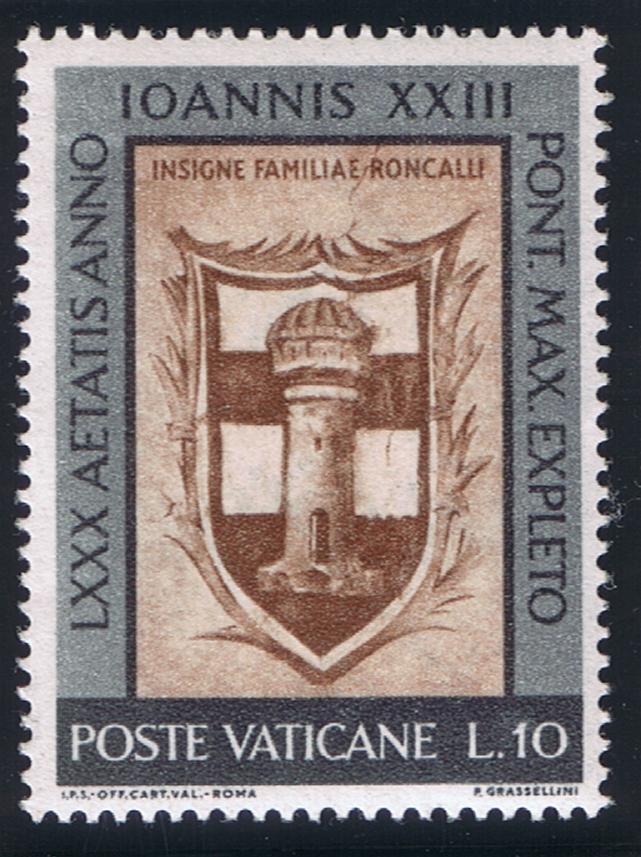


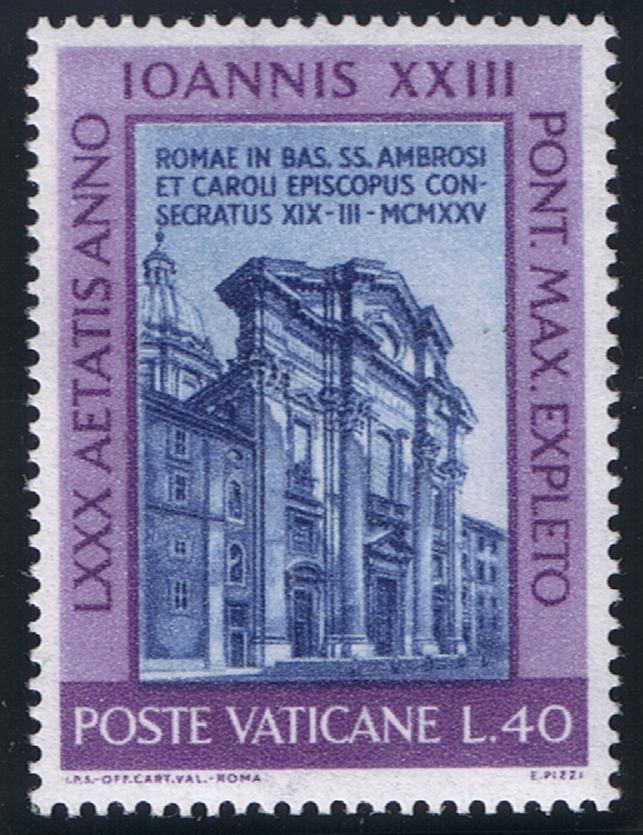
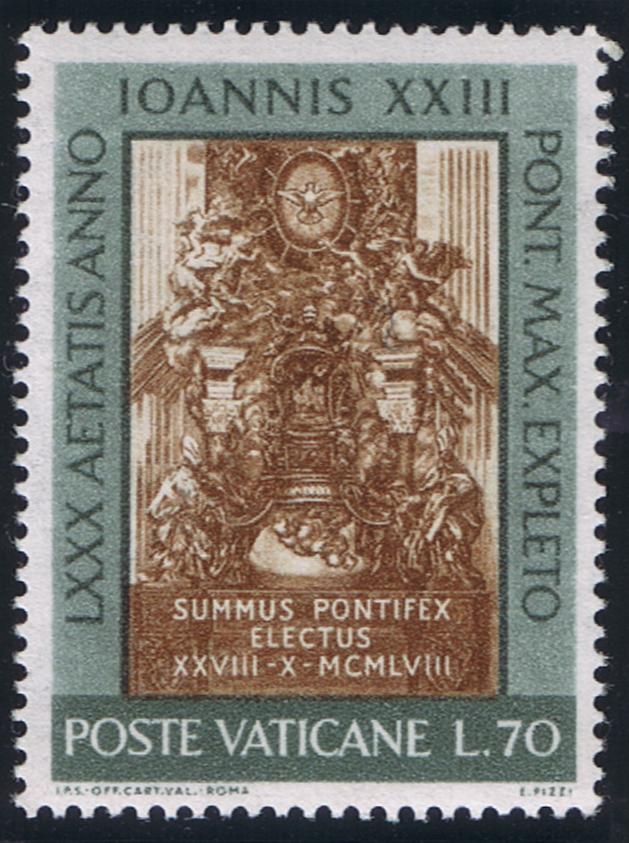
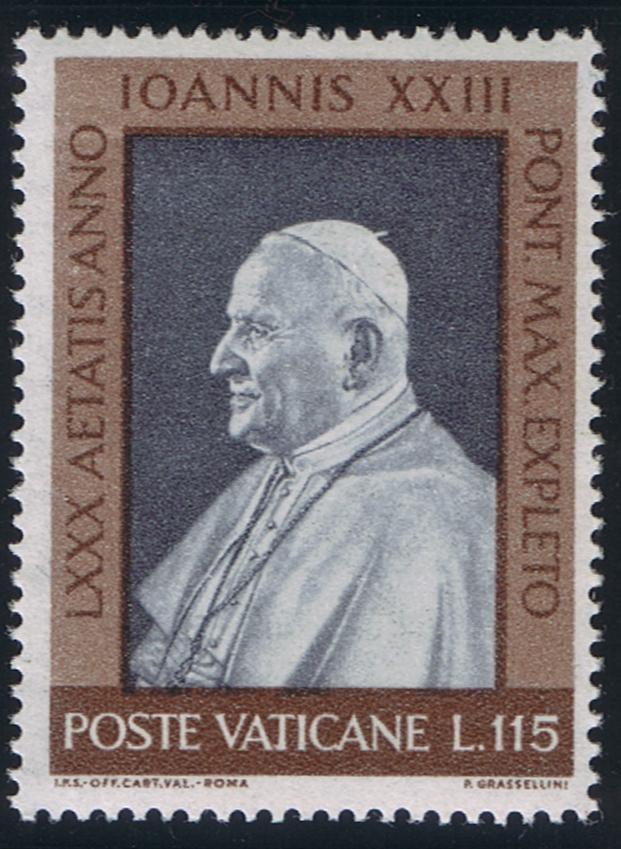
L.10. The Coat of Arms of the Roncalli Family. The Roncalli family first came to Sotto Il Monte in 1420, when the founder of the family moved from Valle Imagna. His name was Martha's Roncalli, called Maitinus. Attempts have been made to link these Roncallis with the Roncalli Family of Bergamo, which was prosperous and attained to noble rank. This Pope John XXIII discounted. Lire 25. The Church of the Baptism of Pope John XXIII. On the night of November 25, 1881, the first son was born to Giovanni Battista Roncalli and his wife, the former Mariana Mazzola, their third child. The Pious mother insisted that the infant be wrapped in warm clothing and be taken to church for immediate baptism. There was a wait for the priest who was rather reluctant to venture out on that cold and rainy evening. But the child's father insisted: "We have been waiting a long time for him and we want him baptized tonight." So in the Church of St. Mary in Briscio, in the Commune of Sotto II Monte, Angelo Giuseppi Roncalli was baptized. As a priest, as an archbishop and as Patriarch of Venice, he often returned to Sotto II Monte to spend a few quiet days with his family and at these times celebrated Mass in the church of his baptism. The Church of St. Mary is shown on the stamp as well as the date of his baptism. The First Day of Issue of this set of stamps was actually the 80th birthday and 80th anniversary of the baptismal day of Pope John XXIII. Lire 30. The Church of the Ordination to the Priesthood of Pope John XXIII. At the age of twenty-three, having completed four years of theological study at the Collegio Ceresoli in Rome, Angelo Roncalli was ordained a priest on August 10, 1904, in the Church of Santa Maria in Monte Santo (St. Mary on the Holy Mount) in the Piazza del Popolo, Rome, by Bishop Cepperelli, Vicar of Rome. On August 11 he celebrated his first private Mass at the tomb of St. Peter, and the same day was presented to Pope Pius X, who encouraged him to be a credit to the priesthood and a consolation to the Church of Cod. He returned to Sotto Il Monte to celebrate his first Solemn Mass for his family and friends in the Church of St. John the Baptist. Santa Maria in Monte Santo is one of the twin churches which stand at the head of the Corso in the Piazza del Popolo. (Cf. VATICAN NOTES, Volume XI, Number 1, Page 9- the July-August Issue of 1962). The other is dedicated to St. Mary of the Miracles. They appear on the design for the 25 and 100 Lire stamps of the Obelisk air mails, illustrated in the Notes at the given citation. Santa Maria in Monte Santo is on the left. Both churches are octagonal in shape, and were said to have been built to replace two chapels which had stood at the head of the Bridge of Sant'Angelo, and which were destroyed because the troops of Charles V had used them as outworks in their attack on Castel Sant'Angelo during the Sack of Rome in 1527. Alexander VII had begun their construction and they were completed by Cardinal Castaldi, the treasurer of Pope Alexander VII, after the Pope's death. A legend tells that a woman had saved for many years and willed 150 Saudi for the completion of the churches. They date from the second half of the seventeenth century, with domes and vestibules designed by Rinaldi and completed by Bernini and Fontana. In a chapel to the left of the main altar in Santa Maria in Monte Santo is a painting by Carlo Maratta (Virtuosi of the Pantheon Set of 1944) of St. James and St. Francis with the Blessed Virgin. Lire 40. Church of the Archepiscopal Consecration of Pope-John XXIII. A special representative was needed by the Holy See for the turbulent Balkans, who could deal with catholic problems with decision and delicacy. Cardinal Tacci, Prefect of the Congregation for Oriental Affairs, placed the name of Msgr. Roncalli before Pope Pius XI, who appointed him to the position. According to customary practice, anyone assuming an important position in Vatican diplomacy was designated at least an archbishop, and so Msgr. Roncalli was named Archbishop of Aeropolis, a Titular See. The designation "Titular See" refers to an ancient bishopric or archbishopric, which now has no catholic population to require the incumbent's presence, e.g. the ancient sees of North Africa. The consecration of Msgr. Roncalli took place on the Feast of St. Joseph, March 19, 1925, in the Lombard National Church, St. Charles Borommeo on the Corso (San Carlo al Corso). The consecrator was Giovanni Cardinal Tacci, and the co-consecrators were Bishop Police, Vice-General of Rome, and Bishop (Later Cardinal) Marchetti-Selvaggiani, Secretary of the Congregation for the Propagation of the Faith. Present was the Bishop of Bergamo, as well as the family of Archbishop Roncalli, and a delegation of the clergy from Bergamo. His first Pontifical Mass was celebrated the following day on the tomb of Peter, to reaffirm his fidelity to the Chair of Peter. The site of San Carlo al Corso was for a long time the location of the national church of the Lombards. At one time there had stood there a church named in honor of St. Ambrose, Bishop of Milan, which was razed in 1651 to make way for the new church named after an Archbishop of Milan, St. Charles Borommeo. This is probably the reason that the names of St. Ambrose and St. Charles are linked on the stamp. The new church has a heavy, poorly proportioned facade and was erected either under Onorio Lunghi or Martino Lunghi, and completed by Pietro or Piero da Cortona. Over the high altar is one of the finest paintings of Carlo Marotta (Virtuosi of the Pantheon 1944) depicting St. Charles in glory with St. Ambrose and St. Sebastian. Under the main altar rests the heart of St. Charles. Lire 70. Election of Angelo Roncalli as Pope. The election of Cardinal Roncalli to be Pope John XXIII is recalled by the Altar of the Chair of Peter, since as Bishop o Rome, John XXIII succeeded to the episcopal chair of Peter on October 28, 1958. At the time that Bernini was constructing the colonnade around St. Peters Square, he was designing a monument to the Chair of St. Peter, which was to be placed in the apse of St. Peters Basilica to enshrine the episcopal chair used by the first pop Originally this chair was of plain oak, but its front and back had been decorated with antique ivory tablets in the ninth century. Rings had been added to admit staves, so that it could be used as a sedia gestatoria. It had stood in the Baptistry of Pope Damasus in the Old St. Peters Basilica and was the obj of veneration before the third century, when the Feast of the Chair of St. Peter was observed on February 22. Urban VIII had it decorated and placed in the new baptistry. Innocent X had placed it in a bronze reliquary. Bernini sketched a small model from which his pupils constructed a larger one. Ws on it began in 1657 and the casting was completed in 1665. It required 191,383 pounds of bronze, more than was needed for the baldacchino. Giovanni Artusi da Piscine directed its casting and Carlo Mattel its guilding. In 1666 on January 18 the present date of the Feast of the Chair of St. Peter, the venerable chair was carried into the choir apse and enclosed in Bernini's monument. The base of this huge bronze is of multicolored marbles, with the statues of St. Augustine and St. Gregory, Latin Fathers, and St. Athanasius and St. John Chrysostom, Greek Fathers, supporting it. Lire 115. Portrait of Pope John XXIII References here given to VATICAN NOTES give biographical information about Pope John XXIII which it is not necessary to repeat here. Volume VII, Number 6, Page 5. Volume X, Number 3, Page 1. Volume XII, Number 1, Pages 1 to 4. Technical Details: Scott Catalogue - 317 - 322 Date Issued - 25 November 1961 Face Value - 10 l, 25 l, 30 l, 40 l, 70 l, 115 l Perforations - 14 Printer - The Italian State Printing Works |
| (From Vatican Notes Volume XIV, Number 2, September - October 1965, Pages 10-11) |