Home
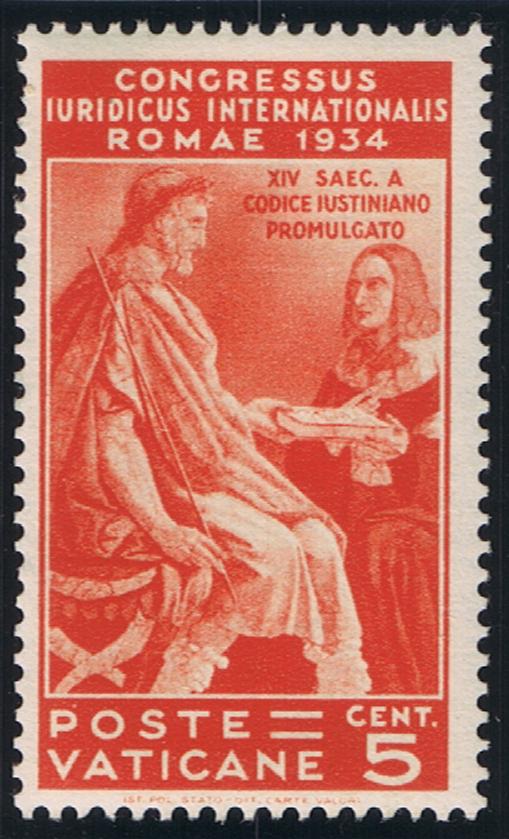


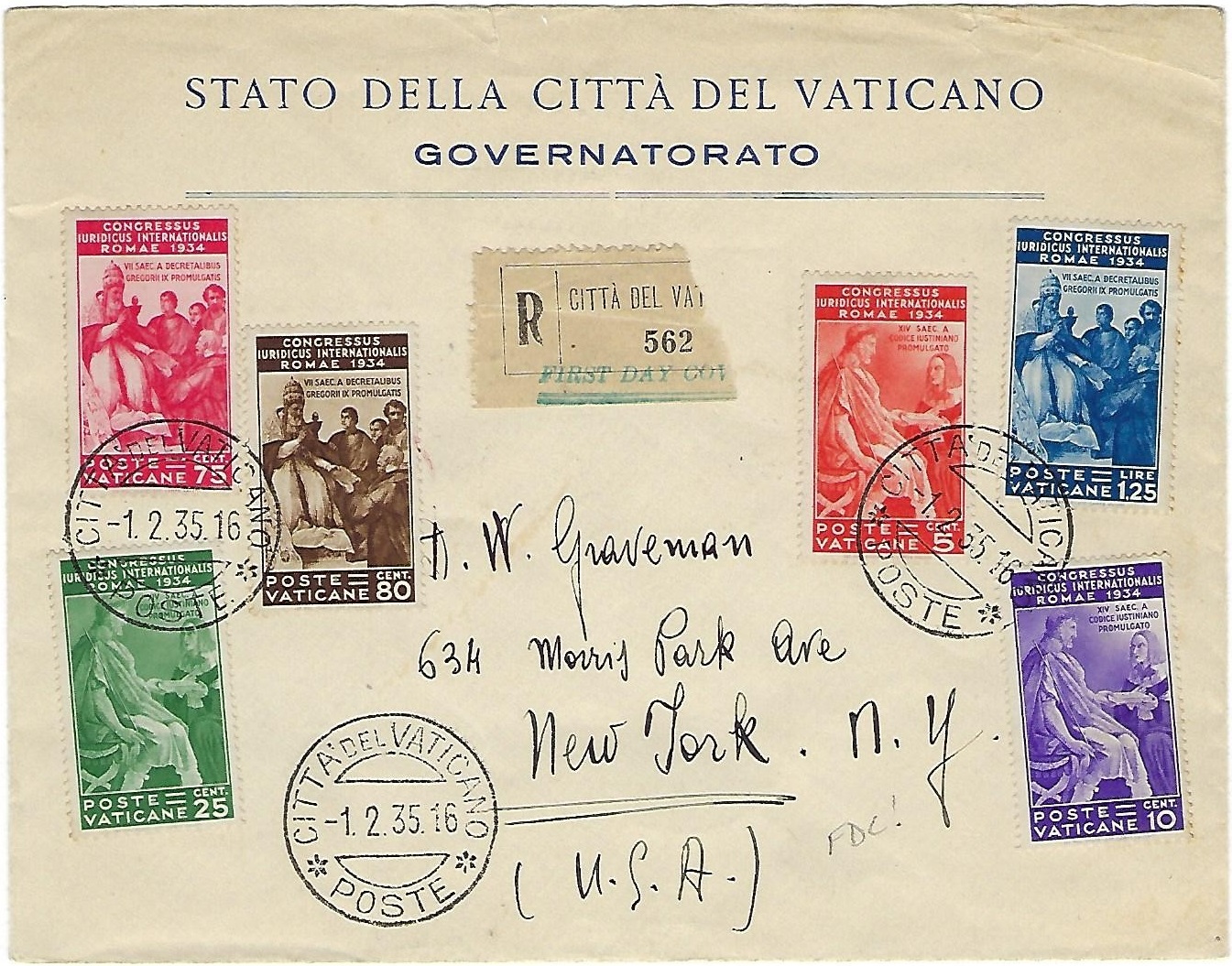
The International Juridical Congress convened in Rome in 1934 to mark the fourteenth centennial of the first codification of Roman Law. The Vatican Postal Administration marked this gathering with a set of six commemoratives of two major designs, each produced on three stamps of the issue. The first design depicts Tribonian presenting the pandects to Justinian I. Justinian I, (Flavius Ancius Justinianus) was born in Tauresium, Dardania, Illyricum, on or about May 11, 483. In the year 527, by advice of his senate, his uncle Justine I proclaimed him a counsel and partner in his empire of Constantinople and Rome. Four months later Justinian succeeded him and became sole ruler of the empire. Immediately upon his accession to the throne, he set himself to the task of collecting and codifying the principal imperial constitutions and statutes in force at that time. When this was compiled Justinian turned his ambitions to the larger task of collecting the commentaries and other writings of the jurists to enable one treatise to digest and harmonize the rulings of the empire. The assembling of this data was entrusted to Tribonian who was assisted in this undertaking by the celebrated professor of law at Berytus, Theophilus. The codification was completed in four years and published in 50 volumes under the title of Digesta or Pandecta in the year 534. While it is this compilation that is depicted on the stamps of this issue, the Justinian Code consisted of four major parts: 1. The Pandects, a digest of the opinions and decisions of former jurists. 2. The Statute Law. 3. The Institutes, an abridgment In four volumes, of all the laws in elementary form. 4. The New Code, the laws in effect at that time as well as Justinian's own edicts. Ten of the ablest lawyers of Justinian's reign aided in forming this famous digest of Roman law as compiled from the Gregorian, Theodorian, and Hermogenian codes. The completed code was submitted to the Emperor Justinian I fourteen years before his death on November 14, 565. The second design of this issue marks the seventh centennial of the promulgation of the Decretals by Pope Gregory IX. Though the Decretals were a codification of Canon Law it was not the first attempt made to compile the ecclesiastical laws of the Church. The first important and most celebrated collection of the canon laws was made by the monk Gratian, about the year 1150. It has been passed through the ages as the "Decree of Gratian." Though widely used and regarded as authoritative, the Decree of Gratian was never more than a private enterprise officially, since it was never regularly sanctioned or adopted by the Holy See. Eighty-four years later, with the assistance of the celebrated Dominican canonist, St. Raymond of Penafort, Pope Gregory IX issued his "Decretals" in five volumes and forbade any further collections of ecclesiastical laws and proclaimed only his Decretals should be used in the study and application of canon law in the tribunals of the Church. Subsequent Popes made additions to the Decretals and Canon Law remained in more or less a confused state until the election of Pope St. Pius X. During his pontificate he proclaimed the first organized efforts of the codification. Though many of the leading jurists pronounced such an undertaking impossible, Pius X proceeded with his plans. Unfortunately he was not to live to see his works published. The honor to proclaim and make this new Code of Canon Law obligatory on the Latin Church fell to his successor, Pope Benedict XV who promulgated the Code on Pentecost Sunday of 1917, and allowed for a period of one year for its study. The new Code became law on Pentecost Sunday, May 19, 1918. |
| (National Philatelic Museum, Volume VII, Number 1, 1954, pages 61-107) We are grateful to the Cardinal Spellman Philatelic Museum for allowing the Vatican Philatelic Society to use the copyrighted text on our website. |