Home
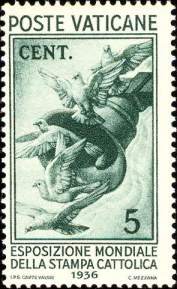

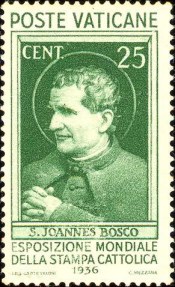

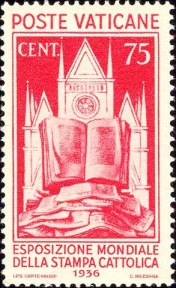


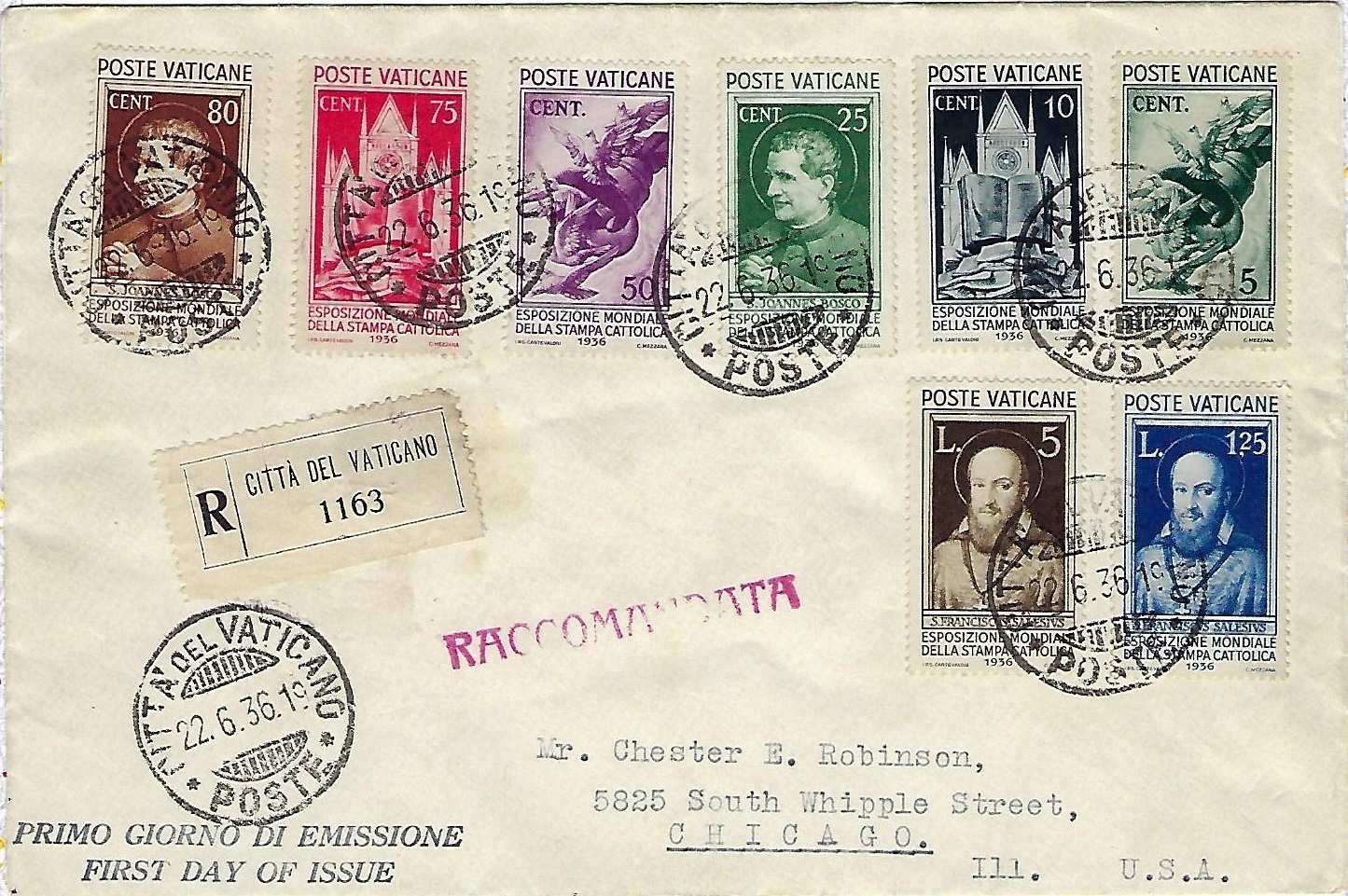
To mark the International Catholic Press Conference assembled at the Vatican, a commemorative set of eight stamps was issued on June 22, 1936. The 5 and 50 centesimi values bear a symbolic design as their motif, a ringing bell and a flight of doves. This design represents the purpose of the Catholic Press, to conduct a good and pure press to spread peace throughout the world. The second symbolic design is the opened Evangile upon the facade of a church. This symbol on the 10 and 75 centesimi values represents the need for a Catholic Press. The third major design of the issue bears an effigy of St. John Bosco, who was the founder of the Salesian Religious Order established chiefly for the education of youth. This young saint opened his eyes for the first time on August 18, 1815, in a hillside village known as Becchi, in Italy. His early years were passed as a shepherd with his parish priest as his first teacher. In later years John attended the Seminary of Chieri to become a priest. He was ordained by Archbishop Franzoni and assigned to the diocese of Turin. Upon visiting local jails he resolved to help save the juvenile delinquents. He actually started this work on the feast of the Immaculate Conception, in 1841. By 1846, his group consisted of more than 400 wayward lads learning the correct way of life. In 1868, with fifty-odd priests who had aided him, John Bosco formed the Salesian Order. Upon his death on June 9, 1868, the order had grown to include the caring for 130,000 children in 250 houses throughout the world. For his work and saintly life young Bosco was declared Venerable on July 24, 1907, by Pius X. On June 2, 1929, he was declared Blessed then solemnly canonized by the same Pope, Pius XI on November 28, 1933. The second saint to be depicted on the stamps of this issue is the patron saint of the Catholic Press, St. Francis of Sales. Francis was born to noble and pious parents on August 21, 1567, near Annecy. His father had planned a state career for this brilliant youth and sent him to Paris and Padua for his studies. Upon his return from Italy he renounced the career of government service and entered the priesthood to which he was ordained in 1593. When the Duke of Savoy decided to restore the Church in the Chablais, Francis volunteered for the task. Along with his cousin Louis as a companion, he proceeded to Le Chablais, where he met strong opposition. He was quick to overcome his foes and it is said that he succeeded in converting 72,000 Calvinists to Catholicism. In 1602, he was made a Bishop and assigned to the See of Geneva, by Pope Clement VIII. With the aid of St. Jane Frances de Chantel, he founded the Institute of the Visitation of the Blessed Virgin, in 1607. The main reason of this order was for the young girls and widows who physically could not endure the hardships of other religious communities. His death came on December 28, 1622, while visiting in France. Pope Alexander VII pronounced his Beatification in 1661, and his canonization four years later. |
| (National Philatelic Museum, Volume VII, Number 1, 1954, pages 61-107) We are grateful to the Cardinal Spellman Philatelic Museum for allowing the Vatican Philatelic Society to use the copyrighted text on our website. |