Home
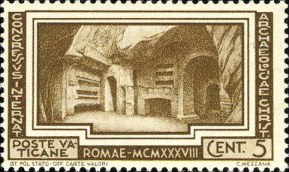

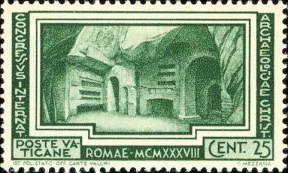
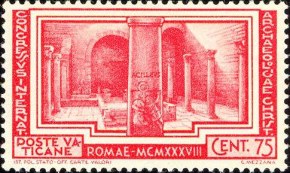
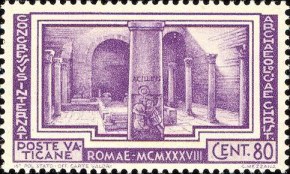
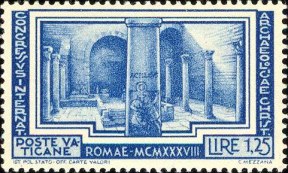
This set of commemorative stamps was released on October 12, 1938, to mark the gathering of scholars and students interested in the catacombs and their restoration. This issue of six stamps had two major designs, each common to three of the values. The first design is a representation of the huge first crypt of the catacombs of St. Calyxtus on the Via Appia. Saint Cecelia was a young and beautiful maiden of noble Roman birth who lived in the later part of the second century during one of the persecutions of the Christians. She was sentenced to death by suffocation for her refusal to renounce her faith. To carry out this cruel torture she was placed in a hot-air bath with the temperature rained 700 %. Though she remained in this torture chamber for a full day and night, she was unharmed. Finally, the emperor's lictor was sent to sever her head from her body. After the three blows allowed by law were struck, her head was only half severed and she remained fully conscious. The trembling lictor left her this way on the pavement of the bath, to die an agonizing death that was to last for another two days and nights. Death finally came to this young virgin saint in 177 A. D. and she went forth to join her Maker. Her earthly remains were placed in the crypt of the Caecitti in the catacomb of St. Cultistus. In the year 817, by order of Pope Paschal I her body was exhumed and enshrined beneath the altar of the Church of Saint Cecelia in Trastevere. In 1599, while the church was undergoing repairs, Cardinal Sfondrati came upon her body and it was found to be incorrupt. The sculptor Moderna was allowed to see her. He then created a lifesize statue of what he had seen. The three high values of this set depict the remains of the Basilica of St. Petronilla. St. Petronilla was a holy virgin who lived about the end of the first century. Unfortunately, the early christians did not compile long writings and we do not know the full story of her life. It is said that she was the daughter of St. Peter, though this has never been proven. We know from the Gospel that St. Peter was married before his apostleship and his wife had suffered martyrdom for her faith. Another account states that she was a relative of Christi Flavis. This theory has been claimed true with the final proof shown to be her burial in the Catacomb of Flavian Domitilla. Though there has never been actual proof brought forward for either of these alleged stories of St. Petronilla, they are generally accepted stories past through the ages. We are certain however that she was a martyr for her faith from inscriptions found during the excavations of the tomb of St. Domitilla. The excavations have also revealed that an ancient basilica was erected over the tombs of Sts. Petronilla, Narveus, and Achilleus, and bore her name. During the Pontificate of Paul I, the marble sarcophagus containing her remains was transferred to St. Peter's Basilica. After the rebuilding of the basilica, her remains again were moved to an altar dedicated to her at the right side aisle of St. Peter's. |
| (National Philatelic Museum, Volume VII, Number 1, 1954, pages 61-107) We are grateful to the Cardinal Spellman Philatelic Museum for allowing the Vatican Philatelic Society to use the copyrighted text on our website. |