Home

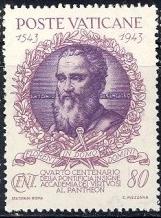
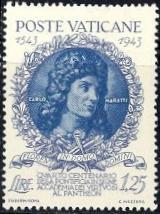

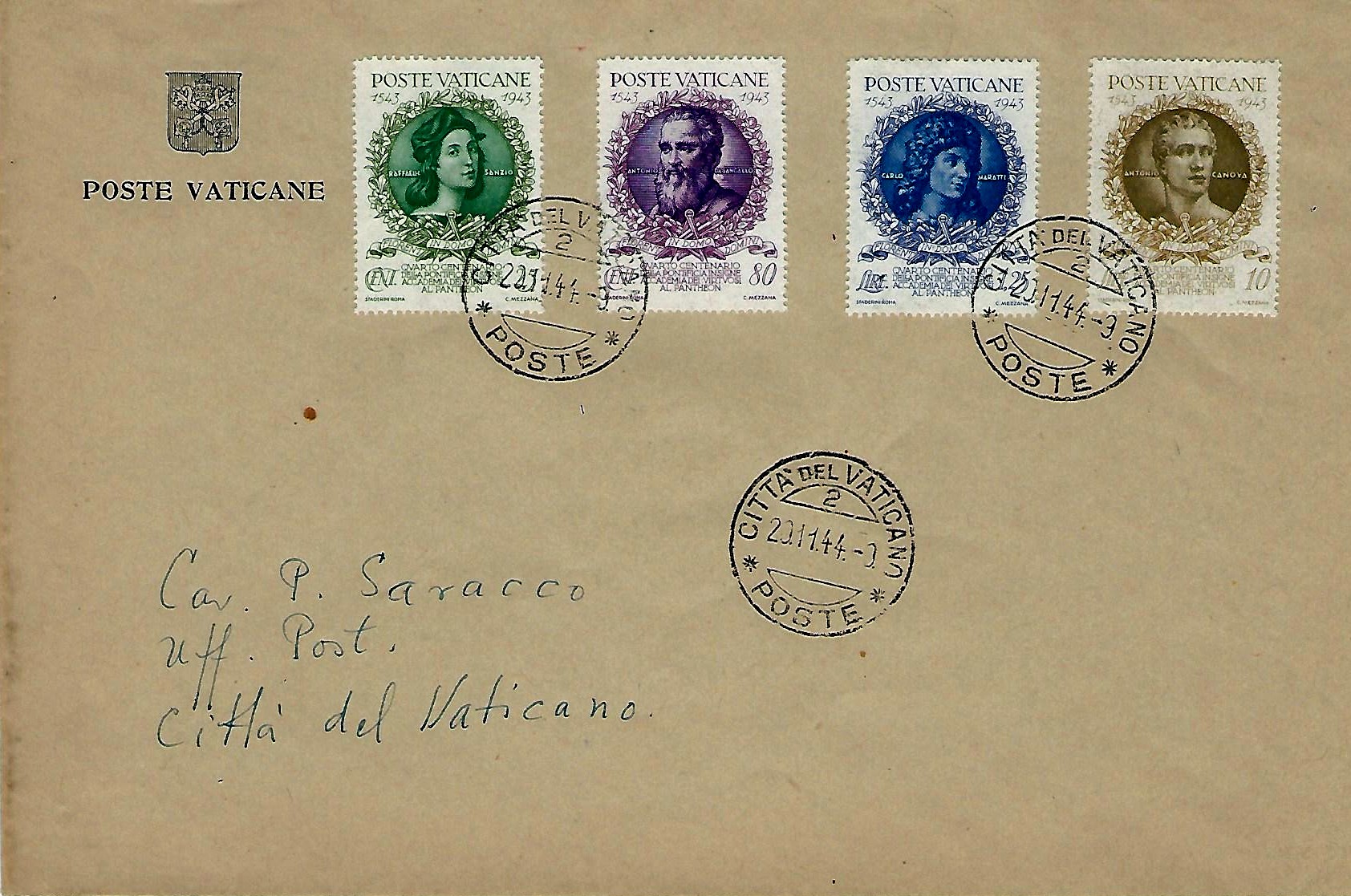
In 1944, a set of four stamps was released to mark the fourth centenary of the establishment of the Pontifical Academy of Virtuosi at the Pantheon. The academy was formed by Pope Paul III in 1542, to promote Christian art, painting, sculpture, and architecture. Membership is by invitation only and granted to men of outstanding achievements in the fields of the Christian arts and sciences. The Painter Prince, Raffaello Sanzio, more commonly known as Raphael is portrayed on the twenty-five centesimi value. Raphael was born in Urbino, Italy in 1483. He is recognized as one of the greatest religious painters of the world and the supreme painter of the Madonna. In his early years he studied with Perugino. In 1504, he journeyed to Florence to profit from the work of Leonardo da Vinci and Michelangelo. Four years later he went to Rome and executed the matchless frescoes that adorn "Raphael's Rooms" in the Vatican. In 1509, Pope Julius II appointed him Writer of the Apostolic Briefs. Upon the death of Bramante, Pope Leo X charged him with the task of supervising the reconstruction of St. Peter's Basilica. In 1515, further honors were paid him by his appointment as Prefect of Antiquities. Raphael's short life of thirty-seven, years came to an end in Rome in 1520. Antonio da Sangallo was the famed architect of the New Walls of Rome and the Santo Spirito Gate. The Gate was incomplete when young Sangallo went to his death in 1546. Another of his immortal works of architecture is the Palazzo Farnese, one of the finest structures in Rome. Another painter, Carlo Maratta, is depicted on the third stamp of this issue. Maratta was responsible for restoring the rooms of the Vatican Palace. During his pontificate, Pope Alexander VII entrusted him with the paintings that were to become great masterpieces and one of his crowning achievements, "The Visitation of St. Elizabeth" and the "Flight to Egypt" for the Chigi Chapel of the Cathedral of Siena. The last denomination of this set portrays Antonio Canova (1757-1821) . He was the creator of the new Italian statuary art. Among his great monuments, those to Pope Clement XIII and Pope Clement XIV found in the Basilica of St. Peter, are among his finest. |
| (National Philatelic Museum, Volume VII, Number 1, 1954, pages 61-107) We are grateful to the Cardinal Spellman Philatelic Museum for allowing the Vatican Philatelic Society to use the copyrighted text on our website. |