Home


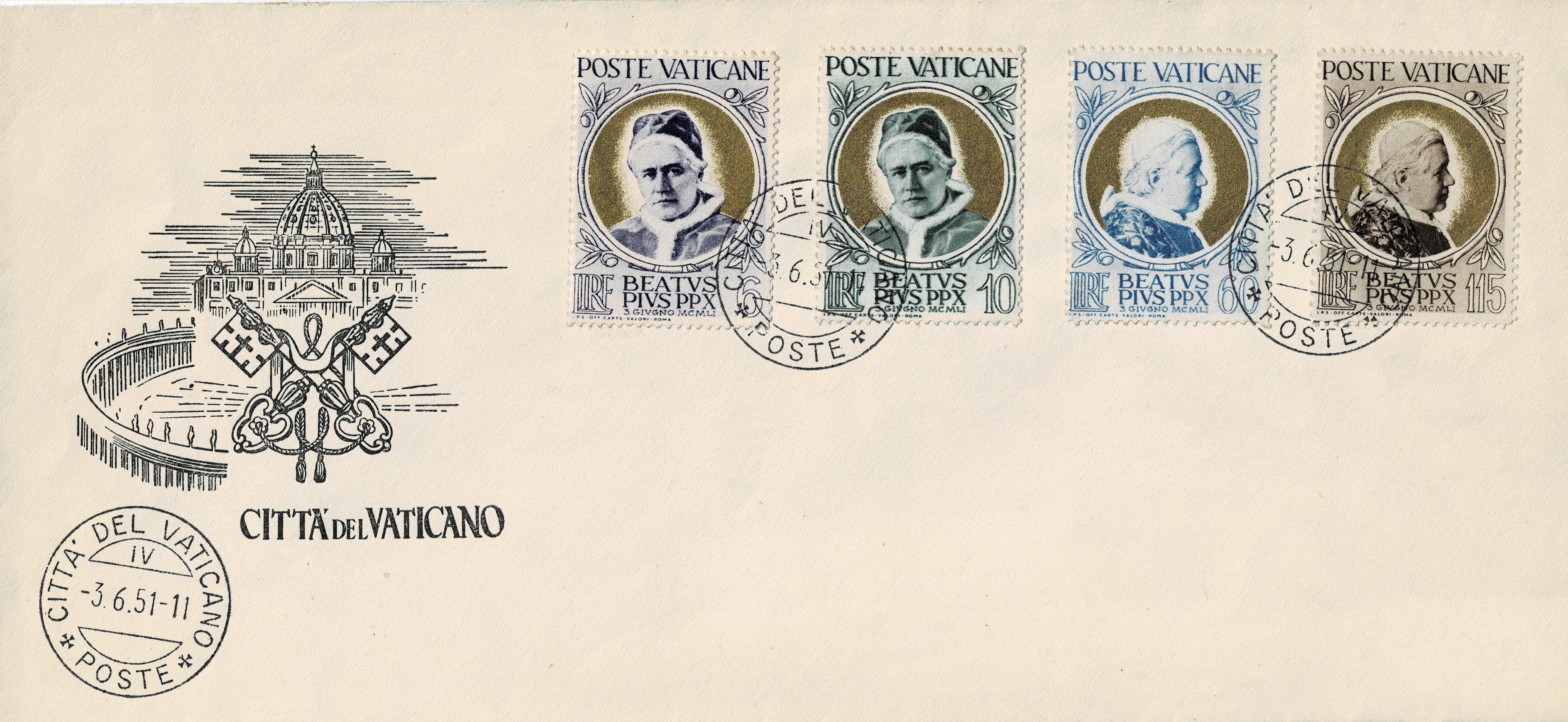
On June 3, 1951, a crowd of 300,000 jammed St. Peter's Square to witness the Beatification of Pope Pius X. This is the first time since 1672 that a Vicar of Christ (Pius V) was elevated to this honor and the eighth time the title of "Blessed" was conferred upon a Pope in the History of the Church. Pope Pius X (Guiseppe Sarto) was born of humble parents at Riese, near Venice in 1835. Before his election to the Chair of Peter, he served the Mother Church as a small village priest, cathedral canon, and seminary professor. He was consecrated as Bishop of Mantua on November 16, 1884, at the Church of St. Apollinaris in Rome. On June 12, 1893, he was elevated to the Cardinalate with four other prelates. On August 4, 1903, he was elected to succeed Pope Leo XII. The crowning achievement of the eleven year Pontificate of Pius X was his Syllabus issued in 1907, condemning works taken by radical writers on modernization of religion. Among the phases of religion the modernists criticized were matters of Christian belief, Biblical criticism, theology, and church discipline. The reign of Pope Pius X also saw the separation of Church and State in France and Portugal. This saintly Pope, also started the inauguration of codification of Canon Law, which was left unfinished at his death. The honor of decreeing the completed codification fell to his successor, Benedict XV. On August 20, 1914, the holy soul of Pius X left this world to join his Heavenly Maker. The Beatification of June 3rd was the rite of conferring the title of "Blessed" upon Pope Pius X, but what does Beatification mean? By Beatification is meant that a holy person, after a long and careful study of his or her acts, and entire life is believed to be in Heaven. This study of the life of the person is begun in their home diocese and ends with the solemn ceremony in St. Peter's. Between these two places all persons acquainted with the person are questioned as to his or her acts. All writings of the tenative Blessed are sent a Tribunal of the Sacred Congregation of Rites. If there is the slightest taint on the life of the person, or the person is found not to have led a holy life the proceedings of beatifying are stopped. If the proceedings prove favorable, the person is pronounced Blessed by the reigning Pontiff and entitled to a limited degree of veneration only in the locality where he (or she) lived and worked, and in the religious communities founded by the newly pronounced Blessed, but not throughout the universal Church. |
| (National Philatelic Museum, Volume VII, Number 1, 1954, pages 61-107) We are grateful to the Cardinal Spellman Philatelic Museum for allowing the Vatican Philatelic Society to use the copyrighted text on our website. |