Home
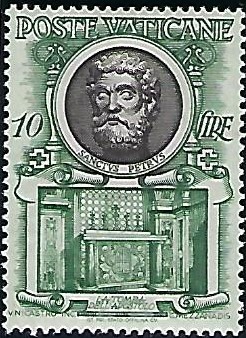


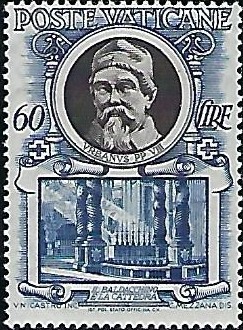
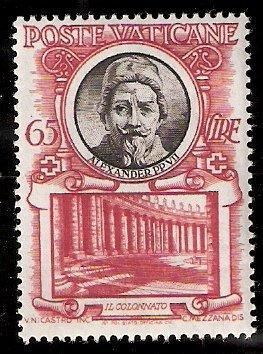

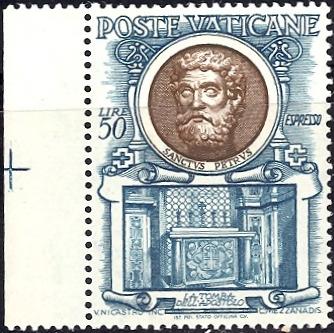

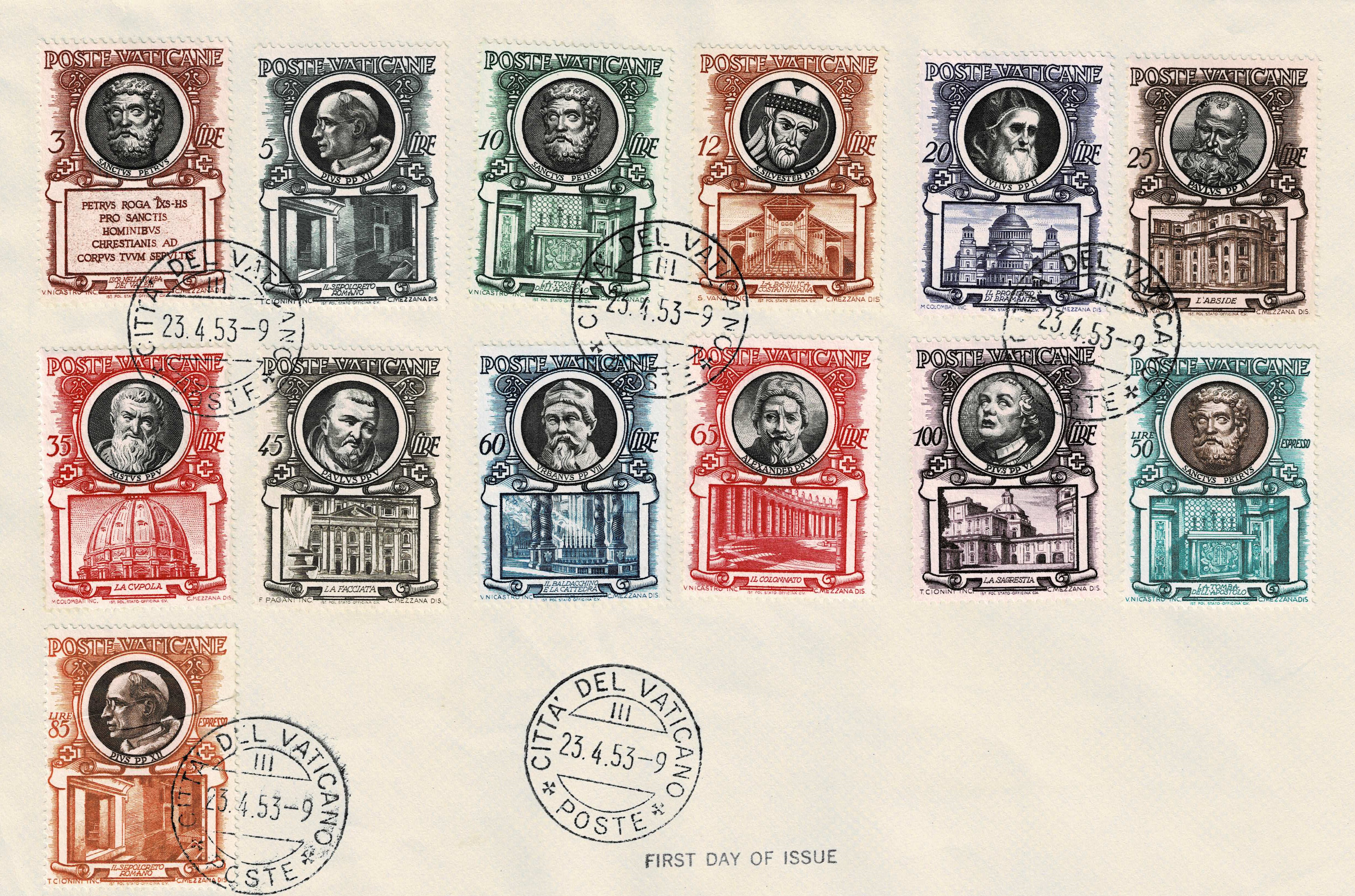
On April 23, 1953, the Vatican released a new set of definitives. By following the designs of the stamps we are able to view the history of St. Peter's Basilica and Popes who played a prominent role in its erection. "Thou art Peter and upon this Rock I will build My Church; and to thee I will give the Keys to the Kingdom of Heaven . . ." These words were spoken by Christ when He made Peter the head of His Church. They are memorialized on the frieze around the dome and transepts of St. Peter's Basilica. Peter
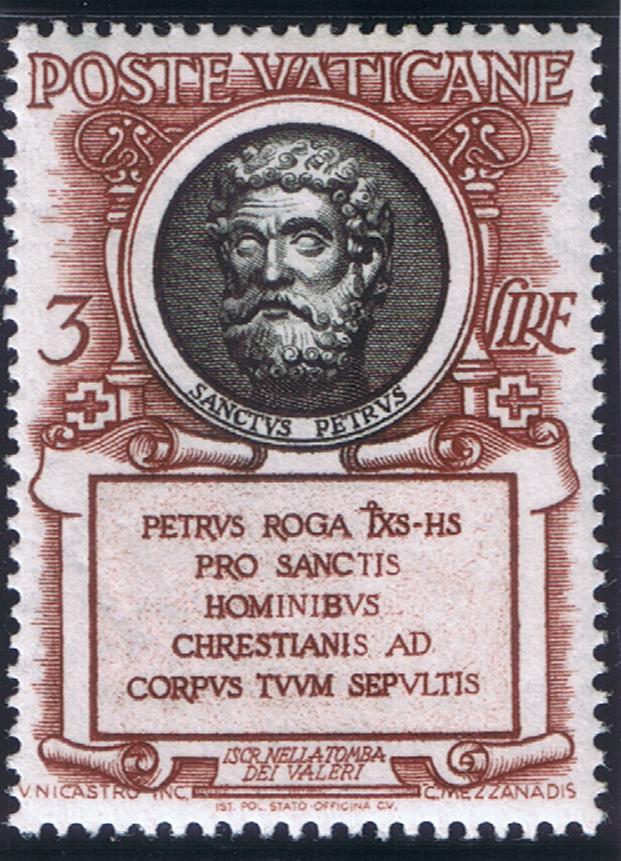
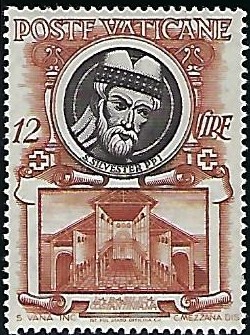
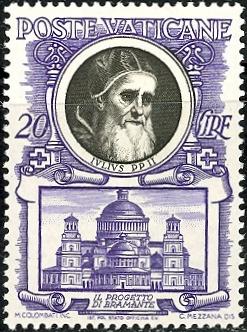
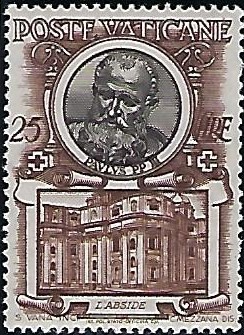
3 L: Saint Peter (Scott 158) 10 L: Saint Peter and Tomb (Scott 160) 50 L: (Espresso): Saint Peter and Tomb (Scott E13) Peter, (derived from petra, meaning rock) was originally called Simon, who followed the life of a peaceful fisherman of Bethsaida. After the Crucifixion of Christ, the Apostles spread to the far corners of the known world. Peter presided over the See of Antioch, where tradition claims he spent seven years. About the year 42, he went to Rome where he was greeted by a small group of Christians. Peter passed twenty-two years in Rome, spreading the Doctrine of Christ. In the fateful month of July, 64 AD, Rome burned. The mobs began to mutter the name of Nero and claimed he started the fires to satisfy his ruthless lust and desires. Upon hearing this, Nero blamed the Christians and ordered the persecution of the band that followed Christ's teachings. In the massacre and bloodletting that followed, St. Peter was captured and thrown into the Mamertime, a dreadful prison at the foot of the Capitol. After being kept in chains for eight or nine months he was sentenced to be crucified. Peter faced his martyrdom with great calm and courage. In a final request he asked that he be crucified with his head down, because he claimed he was unworthy to die in the same manner as his Master. The request was granted and Peter went to join Christ in the year 67. His body was laid to rest in a cemetery in the Via Cornelia. Pope Sylvester I 12 L: Pope Sylvester I and Constantine Basilica (Scott 161) Pope Anacletus, the second successor of Peter, ordered a funeral chapel erected over the grave. This chapel remained until the reign of Pope Sylvester I. During his pontificate the Emperor Constantine was determined to house the tomb as he felt it should be. He ordered a large and magnificent basilica to be erected over the hallowed spot. A great portion of the Vatican Hill had to be cut away to accomplish this task. It is said Constantine himself carried twelve baskets of earth in the excavating, one for each of the Apostles. To Pope Sylvester I fell the honor of consecrating the basilica. He is immortalized on the 12 lire stamp, with a sketch of the basilica as built by Constantine. Pope Julius II 20 L: Pope Julius II and Bramante's Plans (Scott 162) In 1464, the basilica threatened to collapse. The reigning Pontiff, Nicholas V, decided to demolish it and build a new basilica over the tomb. He gave the task to Bernardo Rosellino who began the work. The first stone was laid during the Pontificate of Julius II. He employed Bramante to plan the basilica. Bramante's idea was to build the basilica in the shape of a cross and crown it with a dome. This was very similar to the plans of Julius who wanted to crown Constantine's basilica with a Pantheon. For his part in laying the first stone on April 18, 1506, and supervising its construction until his death, Julius II is depicted on the 20 lire value with Bramante's design. Pope Paul III 20 L: Pope Paul III and the Apse (Scott 163) The next Pope who played a prominent part in the building of St. Peter's was Paul III. He entrusted the work of supervision to the aged Michelangelo. This genius undertook the task in his seventy-second year and refused all offers of pay for his work. He reverted to the original plan of the design of the Greek cross. Michelangelo enlarged the tribune, strengthened the piers of the dome, redesigned the chapels and the apse, and designed the great crowning dome. To this day the dome is referred to as, "Michelangelo's Dome." The great genius left this world in 1564, with only the drum of the dome finished. For restarting the construction Pope Paul III is honored on the 25 lire stamp together with a view of the Apse (rear) of the Basilica completed during his Pontificate. Pope Sixtus V 35 L: Pope Sixtus V and the Dome (Scott 164) The dome of the basilica was finished in 1590. The actual time of the building of the dome is disputed, some claim it took two years while others claim ten years elapsed before its completion. The cost also is disputed. Some claim it cost 200,000 gold scudi while others place it as high as 1,000,000 gold scudi. One thing is certain though, it is a marvelous feat of engineering. It took 600 workmen, skilled in their trade, laboring day and night to finish it. The supplying of the materials to the workmen was a feat in itself. All supplies had to be raised 400 feet by crudely designed implements. For his role in the building of St. Peter's, Pope Sixtus V is shown on the 35 lire value, together with a picture of the dome completed during his reign. Pope Paul V 45 L: Pope Paul V and the Facade (Scott 165) During the first year of the Pontificate of Pope Paul V (1605), the form of a Latin cross again was adopted. Paul V wanted to cover the entire area occupied by Constantine's Basilica and planned to do so with the longer arm of the Latin cross. Carlo Maderno now was the architect-in-chief. He finished demolishing the rest of the basilica erected by Constantine to make room for the longer nave, and the partition wall was knocked down. Under Maderno's directions, the facade (front) of the church was built. The facade is 369 feet long and 145 fett high. The top is crowned with eighteen foot statues of Our Lord and the twelve Apostles. Paul V was honored by the frieze that appears over the arch leading to the Vatican grounds (this arch is part of the facade). It is inscribed "In honorem Principis Apost. Paulus V Burghesius Romanus Pont. Max. AN. MDCXII Pont VII." This is translated to read "In honor of the Prince of the Apostles, Paul V Borghese, Roman Pontiff Maximus, in the year 1612, the 7th of his Pontificate." He is further honored by the 45 lire stamp that bears his portrait along with a view of the facade. Pope Urban VIII 60 L: Pope Urban VIII and the Baldacchino (Scott 166) During the reign of Pope Urban VIII the Baldacchino was built over the tomb of St. Peter. The baldacchino rises one hundred feet above the Altar of the Confession, and weighs ninety-three tons. In front of the altar is a sunken oval space with a marble balustrade. The altar itself is reserved for celebration of the Mass by the Pope only. He reads the Mass while facing the congregation. The erection of the baldacchino (canopy) was not the most important part Urban VIII played in the history of the Basilica. Maderno had finished the basilica and the Pope solemnly consecrated it on November 18, 1626. Urban VIII is remembered for his role in building the basilica, on the 60 lire value. Below the likeness of the Pope is a view of the baldacchino and the Altar of the Confession. Pope Alexander VII 65 L: Pope Alexander VII and the Colonnade (Scott 167) While Alexander VII was the reigning Pontiff, Giovanni Bernini was engaged to build the impressive colonnades. These two rows of columns really are the vestibule of St. Peter's. The colonnades are keyhole in shape, somewhat circular as you enter the square and then straighten out when you reach the basilica. They are purely ornamental and serve no positive need. Each of the colonnades are 64 feet high and 61 feet wide. Between the two colonnades one can count 284 columns arranged in four rows. The spaces between the columns form three covered arcades with the center one in each colonnade wide enough to accommodate two automobiles driving abreast. Atop the rows of columns are 162 statues eleven feet tall. The colonnades form the border of St. Peter's square. The square is 1,110 feet long and 786 feet wide. In the center is the obelisk raised in 1586, by Pope Sixtus V (35 lire stamp) flanked by two fountains. Alongside the fountains are two red and white discs. When you stand on the discs the columns arranged in four rows are so placed that it seems as if only one row is there. For his contribution to the basilica, Pope Alexander VII is shown on the 65 lire value, with a section of one of the colonnades. Pope Pius VI 100 L: Pope Pius VI and the Sacristy (Scott 168) When Pius assumed the responsibilities of the Papal Throne the basilica proper and the square was finished. Wishing to add to the church he set about to build the sacristy. It is a building in itself but attached to the basilica proper by means of two passageways. The sacristy is located about the middle of the left side of the church and consists of four large rooms. Some, of the art treasures found among them are the fluted pillars from the villa of the pagan emperor Hadrian, the vestments worn by Charlemagne when he was crowned the first Holy Roman Emperor by Pope Leo III, three rows of candlesticks and, candelabra, and many rows of chalices and ciboria. To commemorate the erection of this addition, Pope Pius VI is depicted on the 100 lire stamp over a view of the sacristy and the connecting passageway to the basilica. Pope Pius XII
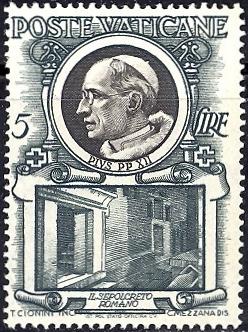
5 L: Pope Pius XII and Roman Sepulcher (Scott 158) 85 L (Espresso): Pope Pius XII and Roman Sepulcher (Scott E14) Pope Pius XII, the reigning Pontiff, is portrayed on the 5-lire and 85-lire stamps. He contributed to the basilica by his great and active excavations below the church. These excavations have unearthed many startling discoveries hitherto unknown to the world. These diggings under the basilica are known as the Sacred Grottos. A visit to the grottos finds a sort of a basilica with a nave and two aisles artificially illuminated with great skill. The grottos have served as a burial place for Popes, Cardinals, and Sovereigns. They now are adorned with statues of personages of fame, chapels, and the life and history of the Popes buried there. The new designs by Pius XII practically have doubled the size of 'the grottos as they appeared during the reign of his predecessor, Pope Pius XI. |
| (National Philatelic Museum, Volume VII, Number 1, 1954, pages 61-107) We are grateful to the Cardinal Spellman Philatelic Museum for allowing the Vatican Philatelic Society to use the copyrighted text on our website. |