Home


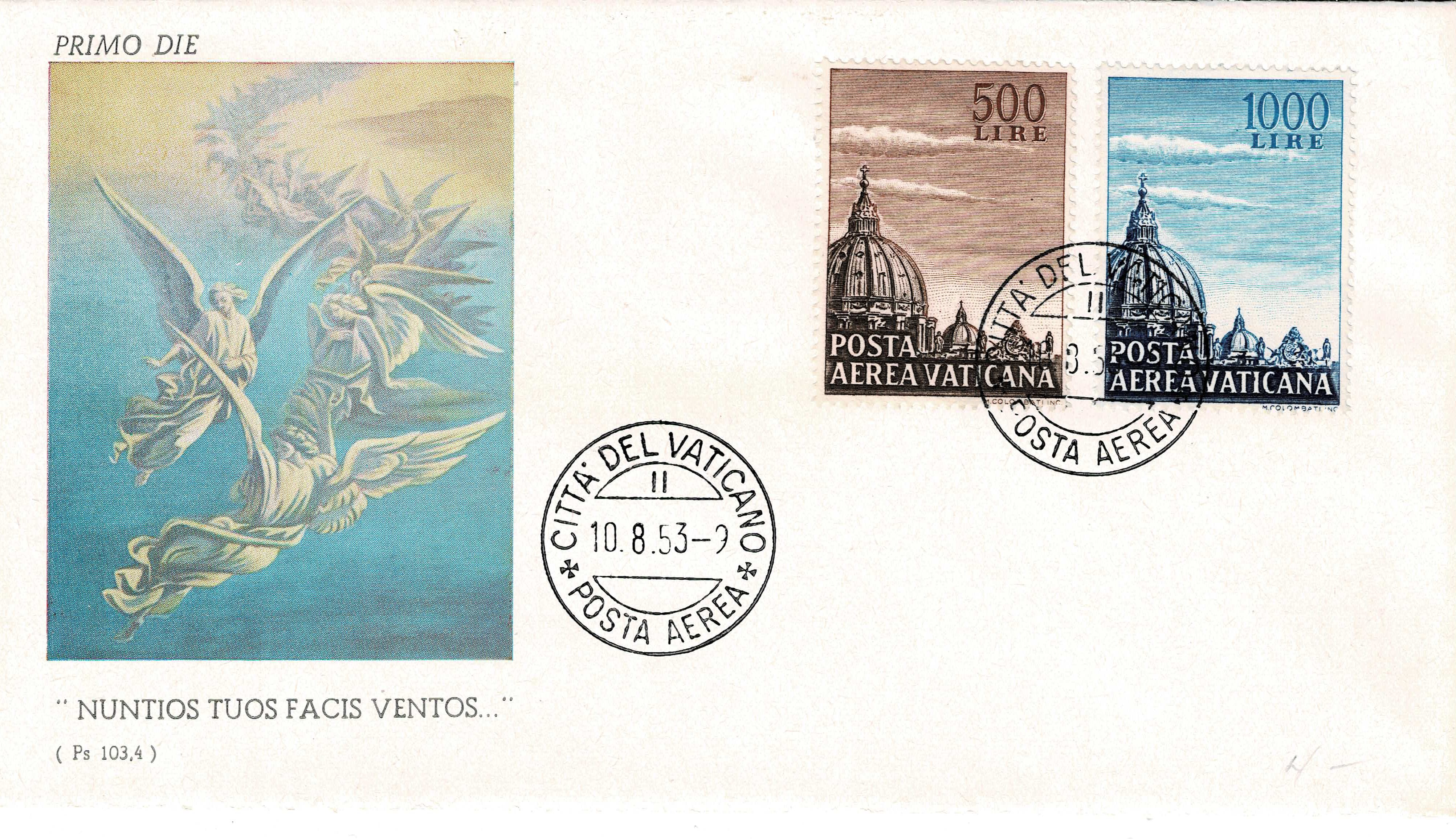
On August 10, 1953, just four months after the release of the definitives telling the history of St. Peter's Basilica, a set of two airmails depicting the dome was released. It is very appropriate that this segment of the basilica honoring the first Pope have an issue of its own. Respectfully called, "Michelangelo's Dome," it is the most impressive architectural feat ever undertaken on the Italian peninsula. The first thought of erecting a crown in the form of a dome over the tomb of the first Apostle dates back to 1503, when Pope Julius II engaged the noted Bramante to design and erect a new basilica to replace the one built by Constantine. Bramante's plan called for a dome directly over the tomb of St. Peter. He never saw his plan materialize as he died long before it could be started. For almost a half-century the dome, or cupola as it is sometimes called, was not heard of again. During the Pontificate of Pope Paul III, Michelangelo was appointed to supervise the planning and building of this new edifice. He was given complete authority to alter, remodel, or demolish any part of the church that did not conform precisely with his plan. As a result, a number of changes were made including the scrapping of Bramante's plans. Before the cupola could be completed Michelangelo was called to his final reward at the age of 89. After his death in 1563, nothing more was added to the dome for a period of twenty-four years. During this time only the drum of the dome erected before Michelangelo's death was completed leaving the work in progress below exposed to the varying havocs of the seasons and elements. In 1588 Pope Sixtus V became impatient and ordered the work on the dome to be finished. The order further stipulated that the plans and measurements laid down by the deceased genius were to be strictly adhered to. As a result of this Papal order, the dome was completed in a period of twenty-two months. |
| (National Philatelic Museum, Volume VII, Number 1, 1954, pages 61-107) We are grateful to the Cardinal Spellman Philatelic Museum for allowing the Vatican Philatelic Society to use the copyrighted text on our website. |