Home

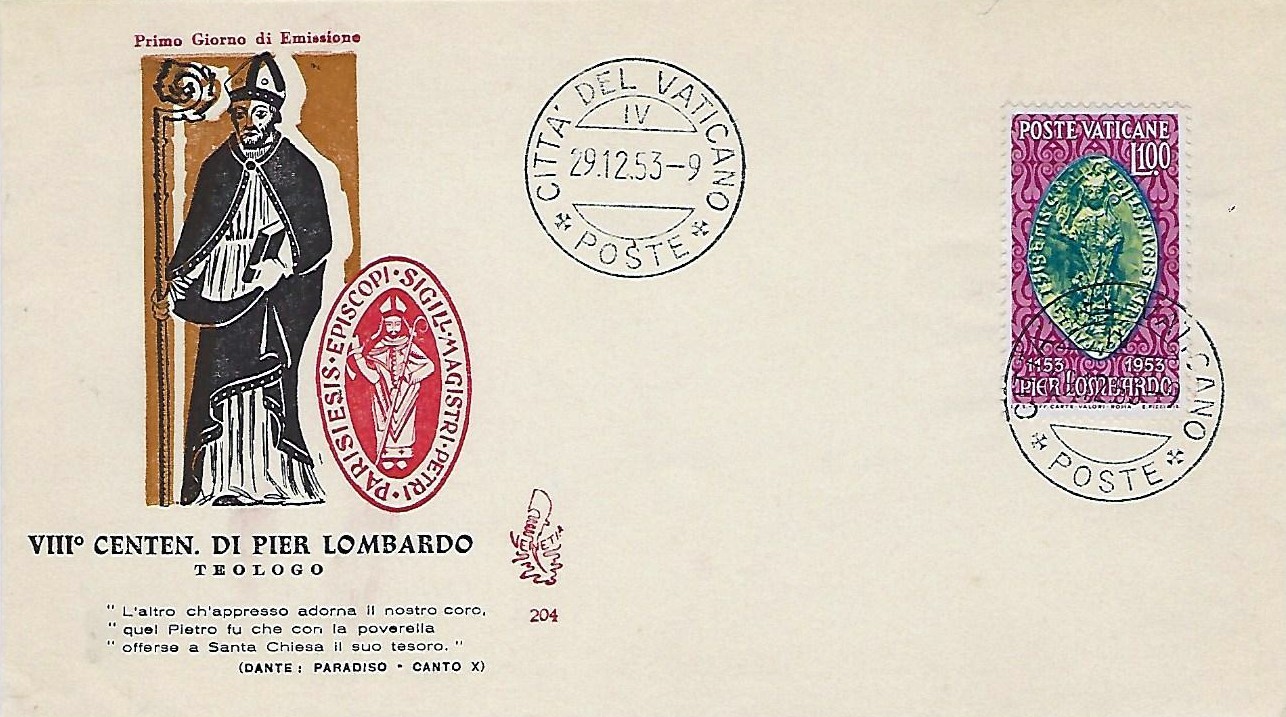
On December 29, 1953, Vatican City released a single stamp of the 100 lire denomination without any advance notice. The stamp has been generally accepted as the Pier Lombardo issue. No issue of Vatican City to date has caused as much a turmoil as this one. Hundreds of collectors have written to find out who Pier Lombardo (Peter Lombard) was, what were his works, and why a stamp was issued in his honor. After months of research, both here and abroad, we are pleased to list all the known facts to date about Peter Lombard and the issuance of this stamp. The Man Peter Lombard was born in 1100, at Novara or Lumello, Italy. He studied at Bologna, Rheims and Paris. In 1158-59, he was appointed as Archbishop of Paris but held the office only a very short time. He met his death not later than 1164, (exact date unknown) never returning to Italy, the land of his birth. His Works The works of Peter Lombard, the Archbishop of Paris consisted of: 1. Commentaries on the Psalms of St. Paul. 2. Sermons. 3. The Sentences known as "Quartutor libri Sententiarum." It was the Sentences, a theological work covering all theology systematically and well, that gave him his fame. His chief sources of information were Abelard, Francis Gratian (see airmail stamps of 1951), Ivo of Chartres, and Alger of Liege. The Sentences were mainly a compilation with less than ten lines being the original work of Archbishop Lombard. It was his aim to compile one book that would end the need of references to many books for information. His works on the Sentences were used up to the sixteenth century as the textbook for university courses and earned for Peter Lombard the title of Magister Sententiarum (Master of the Sentences). The Stamp The stamp issued as the Pier Lombard commemorative depicts the Episcopal Seal he used as Archbishop of Paris. The seal is of white wax (a color very infrequent in Episcopal Seals) and oval in shape. The inscription on the seal reads "Sigillum Magistri Petri Parisiensis Episcopi." The figure in the center of the seal is an effigy of Peter Lombard in Pontifical garb with a banner. His right hand is raised for benediction, while the pastoral cane is held in his left hand. The mitre (official headdress of bishops) worn by Peter Lombard and reproduced on the seal, is unique. It was the first time the mitre appeared with two horns, a style originated by the Archbishop of Paris. A careful examination of all seals and documents prior to the eleventh century reveals that no example of the mitre in this style existed before Peter Lombard. After Peter's inauguration of the horns it was adopted by a number of bishops including: Archbishop Hugo of Rouen (1154), Archbishop Guglielmo of Sens (1169-77), and Bishop Arnolfo of Lisieux (1170). Bishop Arnolfo revised the mitre by adding an ornate cord to separate the two horns. Among the Bishops who wore this revised version of Lombard's mitre were Bishop Cuniberto of Torino and Bishop Alteremanno of Trent. The style of the mitre with horns began to die out in the second half of the twelfth century. The seal of the Archbishop of Paris, Peter Lombard, is important because it preserves the only known picture of a great person. The original seal is housed in the Archives of Paris. Stamp Commemoration While the common name applied to this stamp is the "Peter Lombard Issue," it really was issued to mark the seventh centenary of Lombard's "Quartuor libra Sententiarum" more commonly known as the "Book of Sentences" or the "Book of Opinions". The Episcopal Seal of the Archbishop of Paris was chosen as the main design of the stamp as it was reproduced in the libiri Sententiarum which this stamp commemorates. Designing of the Stamp While this stamp bears a reproduction of the seal, it was Edmondo Pizzi, a noted designer of Vatican stamps, that chose this as the subject. In addition he executed the fine scroll-like work and lettering that completes the design of the stamp. |
| (National Philatelic Museum, Volume VII, Number 1, 1954, pages 61-107) We are grateful to the Cardinal Spellman Philatelic Museum for allowing the Vatican Philatelic Society to use the copyrighted text on our website. |