Home
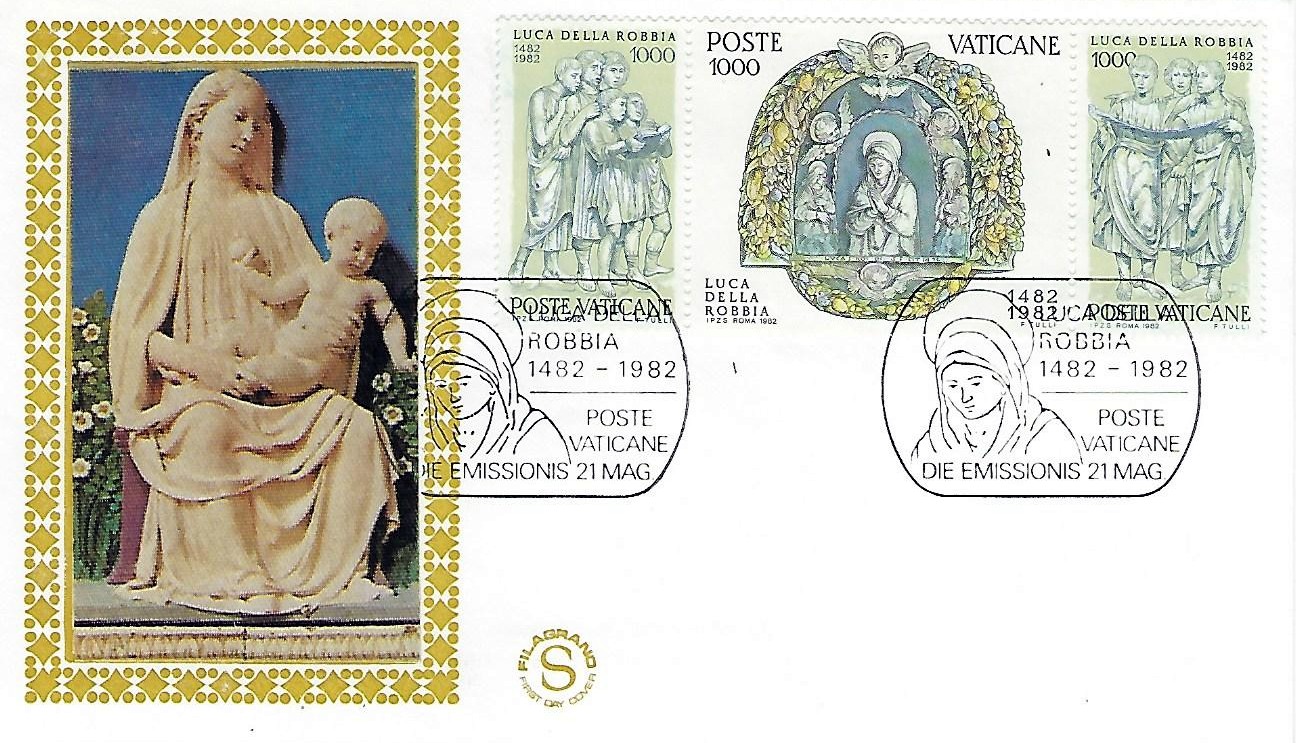
 Luca della Robbia 5th Century After His Death Virgin in Prayer & Pueri Cantores (Singing Boys) 709a (1982) On May 21, 1982 the Vatican issued a triptych to honor Luca della Robbia on the 5th Century after his death. Luca della Robbia was an Italian sculptor from Florence. He is noted for his colorful, tin-glazed terracotta statuary, a technique which he invented and passed on to his nephew Andrea della Robbia and great-nephews Giovanni della Robbia and Girolamo della Robbia. Though a leading sculptor in stone, he worked primarily in terracotta after developing his technique in the early 1440s.  Relief of The Madonna and Child By Luca della Robbia Around 1450 This article recognizes the recent sale of one of his spectacular works of art, circa-1450 Relief of The Madonna and Child. On January 26, 2021, the Albright-Knox Art Gallery in Buffalo, NY sold the artwork at Sotheby’s Auction House for $2,016,500 to a non-disclosed buyer. The artwork exceeded the estimated price of $700,000 to $1 million. The glazed terracotta relief was commissioned around 1450 by the Sforza family of Santa Fiora to Luca della Robbia. It is suspected that Count Bosio I requested the sculpture that remained in the village of Amiata for over 400 years and was sold in 1867 to Leon Mathieu Henri de Somzee, a wealthy art collector from Brussels. Around 1913, the sculpture became the property of Rudolph Bottenweiser who later passed it on to his son, Paul Bottenweiser, a Berlin art dealer who worked in New York City for the Anderson Gallery on Park Avenue. The Madonna and Child from Santa Fiora reached the United States and was sold in 1929 to the Albright-Knox Art Gallery in Buffalo, NY. The Albright-Knox Art Gallery retained the art piece until January 26, 2021, when it sold for over $2 million. The 1929 purchase price is unknown. The following is the condition report for the over 570-year-old Relief of The Madonna and Child as described prior to the recent auction.... “This relief is a rare and exceptional example of Luca della Robbia’s skill in modeling. As with the majority of glazed earthenware sculptures from this period, there are old breaks and restorations. The relief had breaks and original firing cracks that were professionally and beautifully restored. There is also restoration to surface chips including those in the borders, the child’s proper left elbow area, some of the drapery folds on his lap, and some edges of her cloak (on the left side of the image) that are not easily visible. Several of the breaks occurred on the top portion of the relief, including on the blue ground and into the borders at the top third of the relief. There was a horizontal crack from the upper left corner of the border diagonally down through her neck and two others from the central section of the upper border diagonally down through her cheek and forehead above her eyes leading into the top of the child’s head. There is a hairline crack from the center of the left outer border moving upward diagonally, on the blue ground to her veil. The piece is stable and the modeling is outstanding.” References: • Sotheby Auction House: "Property From the Albright Knox Gallery" • National Gallery of Art: "Della Robbia: A Closer Look" Article Links: • James C Hamilton,“The Della Robbia Family - Art & Philately”: Vatican Notes, Vol. 62, No. 359 pp. 16-25 (2014) |