Home
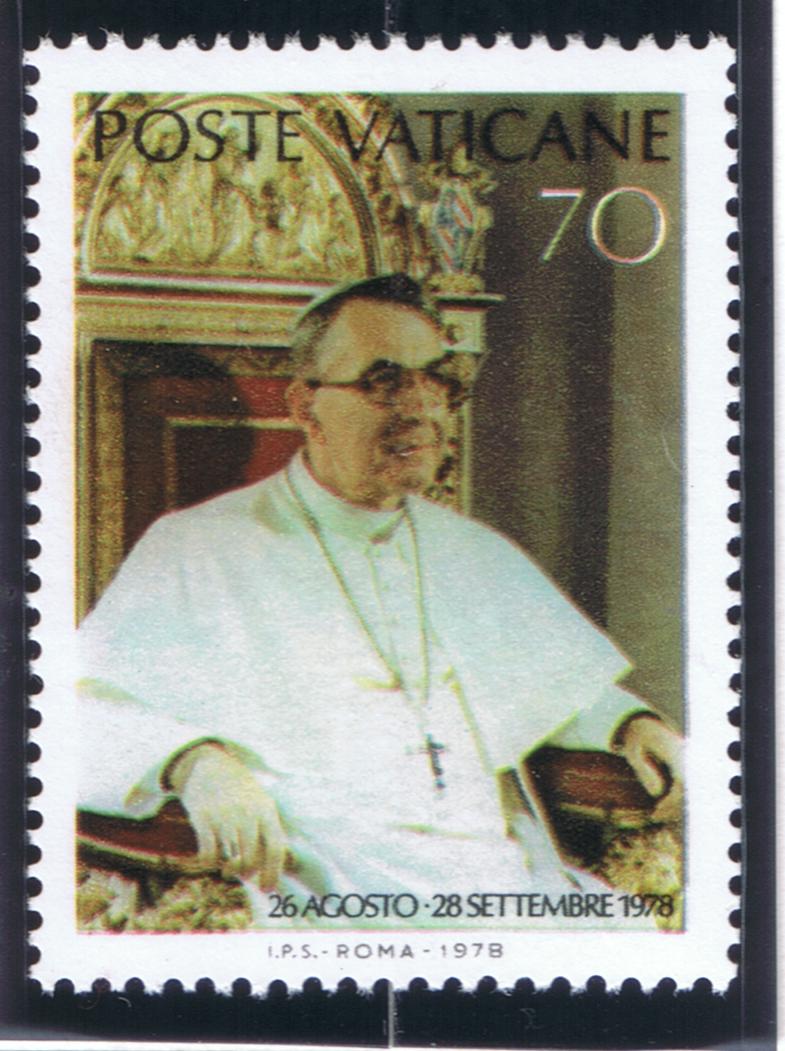
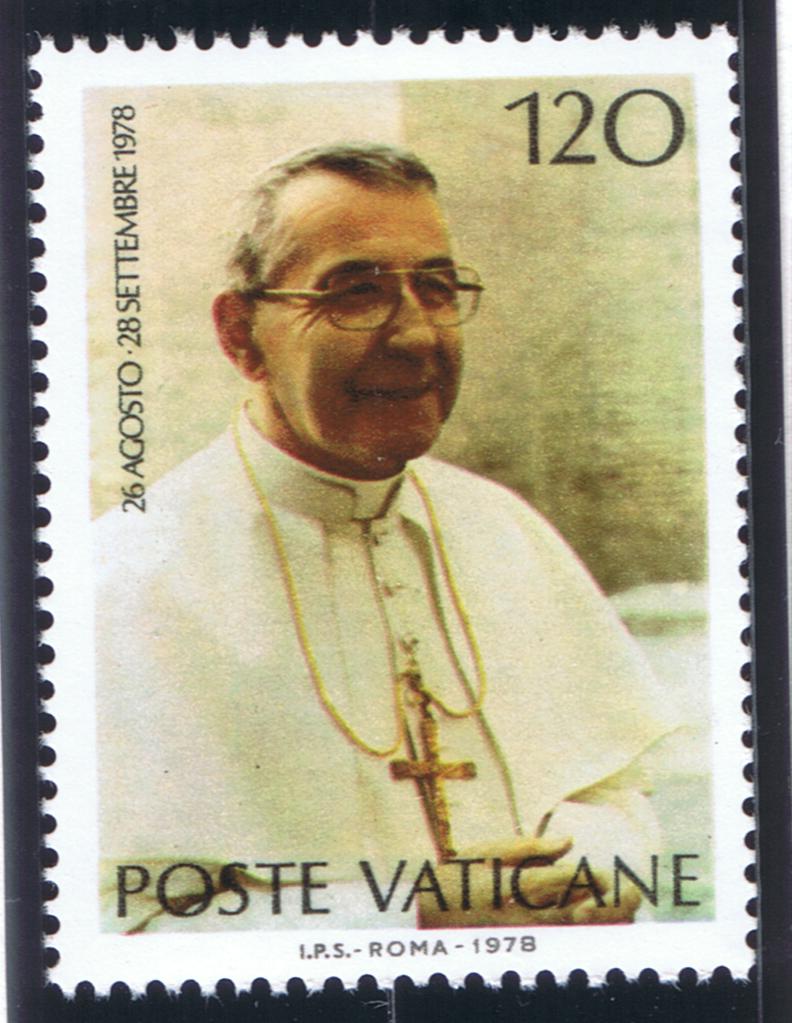
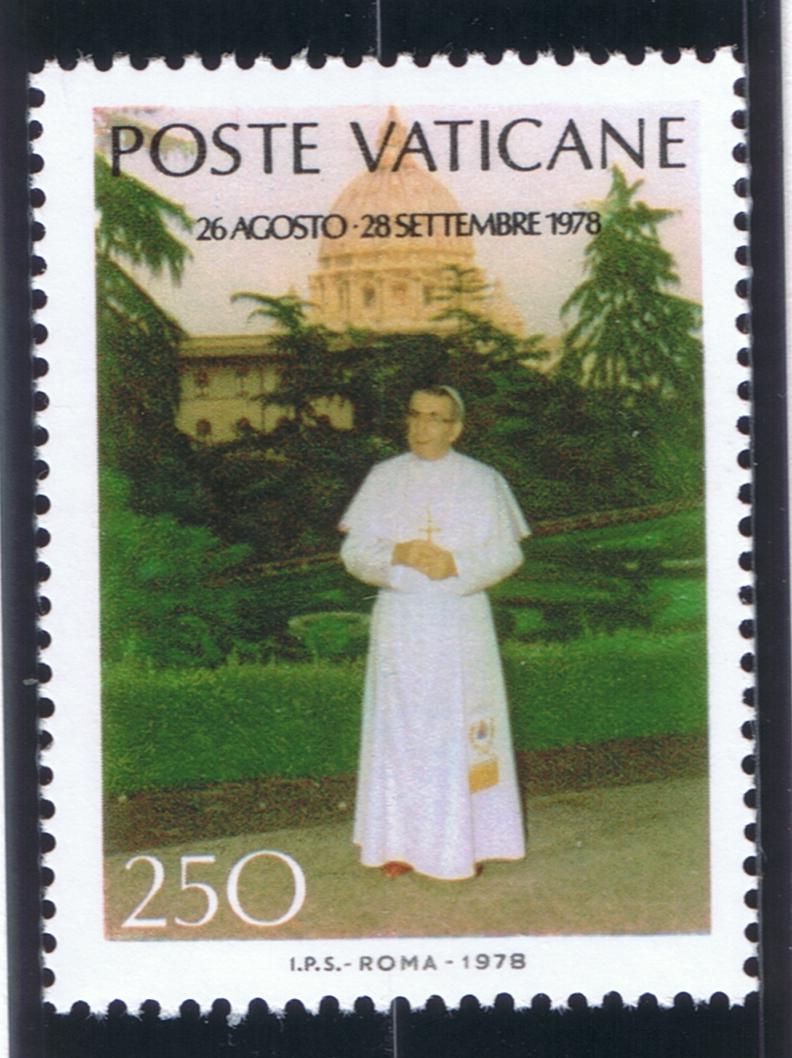
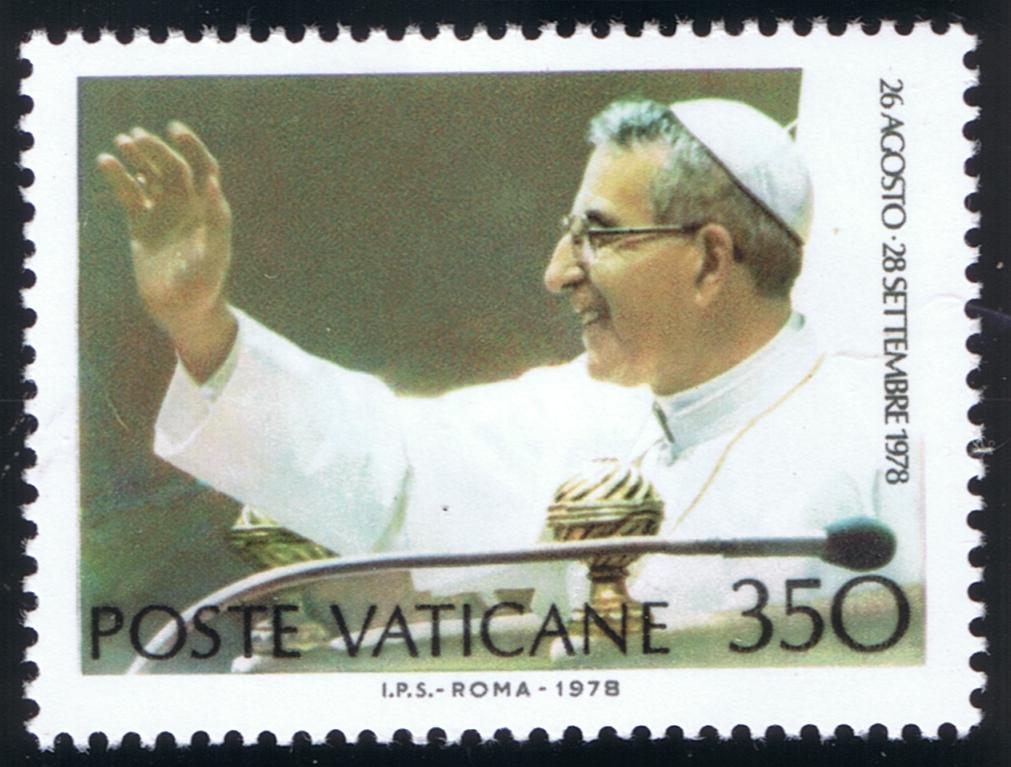
On December 11, 1978, the Vatican Postal Administration placed on sale a set of four stamps to commemorate the Pontificate of the late Pope John Paul I. The subjects for all values of this issue were selected from photographs taken during the Pontiff's short reign, and depict him dressed in the white papal cassack and skull cap. The 70 lire value depicts the pontiff seated on the throne, the 120 lire has a smiling portrait of the late pope, the 250 lire value shows him walking in the Vatican Gardens, and the 350 lire depicts the pontiff sitting on the throne with a microphone in front in the act of giving his blessing. The first three values are vertical in format and measure 30 X 40 mm with a 13 1/4 x 14 perforation. The high value is horizontal in format measuring 40 x 30 mm. and perforated 14 x 13 1/4. The inscription "26 Agosto - 28 Settembre 1978" (August 26 - Sept. 28, 1978), indicating the day of election and day of his death, appears on each stamp in addition to the legend POSTE VATICANE and the stamp denomination. The preparation of the subjects and printing was executed by the State Polygraphic Institute, Rome, Italy. The stamps were printed in 4-color photogravure on white glossy paper, and distributed in sheets of 40. A total of 1,450,000 complete sets were printed. Pope John Paul I was born Albino Luciano on October 27, 1912, in the village of Forno di Canale, presently known as Canal d'Agordo, a rural hamlet at the foot of the Dolomites Alps. The Pope's father was a bricklayer and an activist in the Italian Socialist Party. His mother, Angela, was a peasant; a jovial woman, "strong and devout" as he once described her. Young Albino entered the seminary in Feltre where he received his initial education and later graduated from the Gregorian Seminary of Belluno. On July 7, 1935, he was ordained a priest. At age 23, he went to Rome to pursue his studies at the Pontifical Gregorian University and upon graduation, he returned to his native village to work in the local parish while teaching religion in nearby schools. He moved to BeIluno to join the seminary faculty and in 1937 he was promoted to Assistant Rector, a position he held for ten years. In 1948, Don Albino received the title of Assistant Vicar of the Diocese of Belluno, and in 1958, Pope John XXIII appointed him Bishop of Vittorio Veneto, not far from Belluno. He served his flock for eleven years, with dedication and keen understanding of their socio-economic problems. In 1969, Pope Paul VI elevated him to archbishop and Patriarch of Venice, one of the two most prestigious episcopal seats in Europe; the other being the Patriarchate of Lisboa, Portugal. The Byzantine splendor of St. Mark's Basilica suddenly made this man of humble birth somewhat uncomfortable. He refused to wear the bejeweled piscatorial ring the symbol of his office, and declined to participate in the procession of gondolas in the canals; a traditional event which honors the new Patriarchs of the lagoon city. He requested and received a simple ceremony for his investiture without the official pomp accorded to his two predecessors, Giuseppe Sarto and Angelo Roncalli, who later became Pope Pius X and John XXIII respectively. This man of great personal warmth, spiritual strength, and tireless interest in the poor, won the admiration of Pope Paul VI who elevated the Patriarch to Cardinal at his 4th consistory of March 5, 1973. Five years later, on August 26, 1978, Cardinal Luciani was elected as the 263rd successor of St. Peter by the largest number of Cardinals in the history of the Church on the fourth ballot, on the first day of voting, the shortest conclave in modern history. He was the first pontiff to choose a name never recorded before in the annals of the papacy. Pope Lando (913-914) was the last pontiff to use a name which has not been adopted by any other pope. On September 3, 1978, at 6 p.m. Rome time, John Paul I was installed as the new Head of the Roman Catholic Church. "A Mass for the Beginning of the Pastorate of the Supreme Pontiff", as he preferred to call it, replaced the traditional papal coronation ceremony. The rites were simple and the historical papal tiara, signifying temporal powers, was replaced with the bishop's miter and the pallium. The pallium, placed around the Pope's shoulders, consists of a band of lamb's wool with two pendants and is decorated with six crosses and three gold pins. Traditionally the pallium symbolizes the pastoral duties associated with a metropolitan archbishop. After only 34 days as Pontiff of the Roman Catholic Church, John Paul I died victim of a heart attack. The news of his unexpected death, on September 29, 1978, stunned the Christian world. In such a short time, this obscure but humble pastor achieved wide popularity and was able to capture the affection of Christians and non-Christians around the globe. The funeral Mass and burial took place on October 4, 1978, after laying in state in St. Peter's Basilica for five days. The plain pine coffin containing the pope's body was placed in a sarcophagus of white Turkish marble in a grotto under the Basilica where John XXIII and Paul VI are entombed. His death marked the end of nearly five centuries of unbroken succession of Italians to the throne of St. Peter's, when on October 16, 1978, the Princes of the Church elected Cardinal Karol Vojtyla of Poland as Supreme Pontiff of the Roman Catholic Church. |
| (From Vatican Notes Volume XXVII, Number 6, March - April 1979, Pages 2-3) |