Home
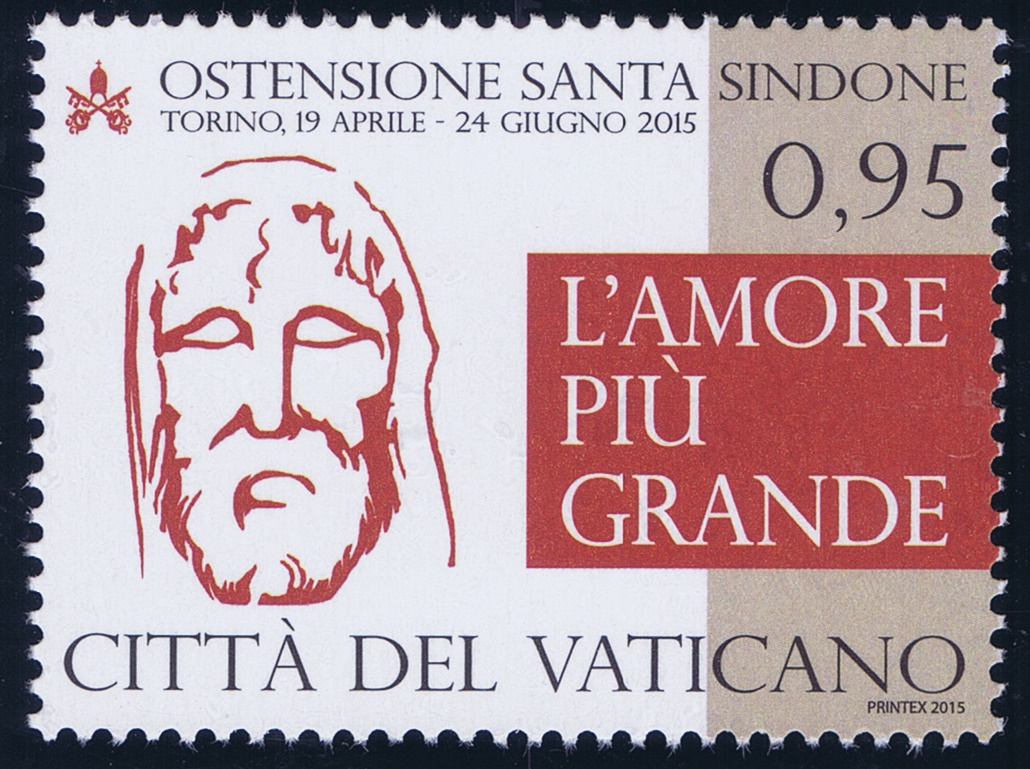
The Exposition (Ostensione) of the Holy Shroud of Turin occurred from Sunday 19 April to Wednesday 24 June 2015. The prior exposition of the Shroud was in 2010. The €0,95 stamp is a sketch of the face on the Shroud. An inscription, L'Amore Pitt Grande (The Greatest Love) is located at the right, center of the stamp. The issue was printed in sheets of ten. The Holy Shroud is located at the Cathedral of St. John the Baptist in Turin, Italy. The shroud is a 14.3' x 3.7' length of linen cloth. Traces of cotton fibers with the linen suggest a Near East, not Western European, origin. The image on the Shroud is of an adult man (5' 11" in height, 30-35 years of age) with a beard and long hair and Jewish or Semitic facial features. The man's body beam marks associated with crucifixion, wounds from piercing on wrists and feet, over 90 marks from beating, as well as blood. The image on the Shroud is much more defined by a photo negative made in 1898. The Holy Shroud has been subjected to scientific analysis, but results have not been conclusive as to its date, its source of origin, and how the image was recorded on the linen cloth. Radiocarbon dating placed selected small pieces of the cloth in late medieval era (1260-1390). Dirt and pollen in the shroud are associated with Israel and the Near East, while limestone fragments are identified with tombs in Jerusalem. Blood fragments have been confirmed as both blood (Type AB) and paint. The paint may have been applied to touch up the image, especially after damage from fire in 1532. During the fire, a drop of molten silver from its reliquary fell onto the cloth. Water was poured on the Shroud to save it from burning. Repair added difficulty to its dating, (14 triangular pieces were sewn onto the Shroud by Poor Clare sisters). The greatest mystery is an explanation of how the image was transferred to the linen cloth. Results of studies and tests have provoked additional, unresolved debate. There are unverified reports about the burial cloth of Jesus, such as the Edessan Image tied to a disciple, Thaddeus of Edessa (by tradition, one of the 70, Luke 10:1). Byzantine icons point to its existence from the 6th century onward. There is no reliable historical documentation about the Shroud of Turin until the 14th century. In 1453 it became the possession of the House of Savoy and in 1578 it was transferred to Turin's cathedral where it has since remained. The House of Savoy presented the Shroud to the Holy See in 1983. The Holy See regards the Shroud of Turin as a holy icon. Acceptance of the Shroud as the burial cloth of Jesus Christ is not a matter of faith and the Holy See has not pronounced on its authenticity. In May 2010 when he visited the exposed Shroud, Pope Benedict XVI stated the Shroud was: "the Icon of Holy Saturday. ...The Shroud is an Icon written in blood: the blood of a man who was scourged, crowned with thorns, crucified, and whose right side was pierced. The Image impressed upon the Shroud is that of a dead man, but the blood speaks of his life. Every trace of blood speaks of love and of life. Especially that huge stain near his rib, made by the blood and water that flowed copiously from a great wound inflicted by the tip of a Roman spear. That blood and that water speak of life. It is like a spring that murmurs in the silence, and we can hear it, we can listen to it in the silence of Holy Saturday."Vatican City also issued an earlier stamp bearing the shroud's face in 1998: (Scott 1073). 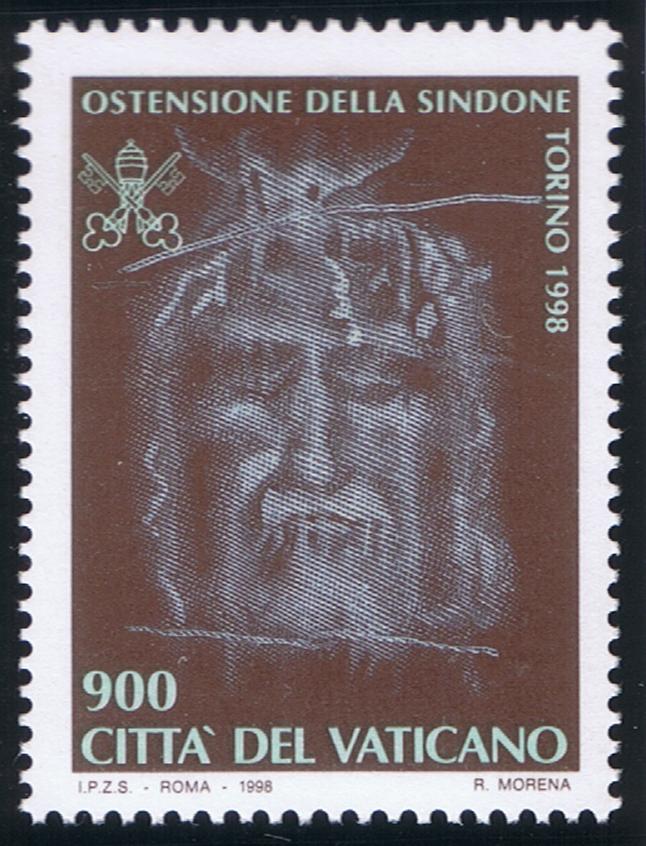 Shroud of Turin, Scott 1073 (1998) Technical Details: Scott Catalogue - 1583 - 1583 Date Issued - 19 February 2015 Face Value - €0,95 Perforations - 13.65x13.77 Printing Process - Offset Printer - Printex (Malta) Max Printed - 250,000 |
| (Source: Vatican Notes, Volume: 63, Issue: 364, pp. 4-6, 2015) |