Home
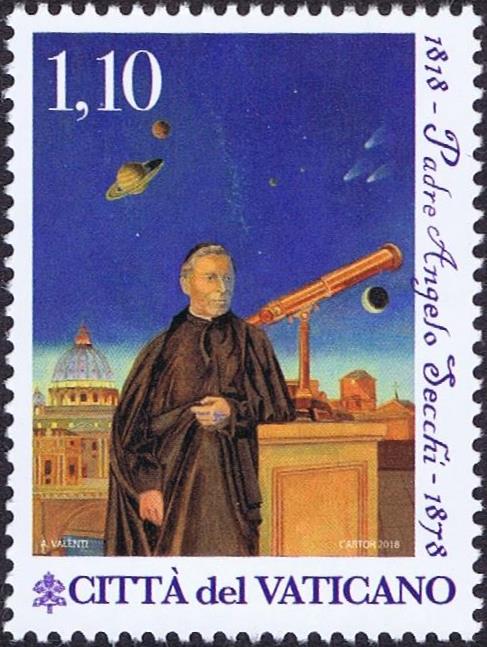

Father Angelo Secchi, SJ. (28 June 1818 – 26 February 1878) was an Italian Catholic priest, astronomer from the Italian region of Emilia. He was director of the observatory at the Pontifical Gregorian University (then called the Roman College) for 28 years. He was a pioneer in astronomical spectroscopy and was one of the first scientists to state authoritatively that the Sun is a star. Among some of his contributions to many areas of astronomy included: discovering three comets, including Comet Secchi; produced an exact map of the lunar crater Copernicus; drew some of the first color illustrations of Mars and was the first to describe "channels" on the planetary surface; observed and made drawings of solar eruptions and sunspots, and compiled records of sunspot activity; in 1860 and 1870, he organized expeditions to observe solar eclipses. Angelo Secchi is depicted on the €1,10 stamp with the characteristic elements of his research, the telescope along with the stars and planets in the sky. St Peter's Basilica appears in the background. Maria Gaetana Agnesi (16 May 1718 – 9 January 1799) was an Italian mathematician, philosopher, theologian, and humanitarian. She was the first woman to write a mathematics handbook and the first woman appointed as a mathematics professor at a university. She devoted the last four decades of her life to studying theology (especially patristics - the branch of Christian theology that deals with the lives, writings, and doctrines of the early Christian theologians) and to charitable work and serving the poor. She was a devout Catholic and wrote extensively on the marriage between intellectual pursuit and mystical contemplation, most notably in her essay "The Mystic Heaven). She saw the rational contemplation of God as a complement to prayer and contemplation of the life, death and resurrection of Jesus Christ. The €1,15 stamp depicts Maria Gaetana Agnesi in prayer with a mathematical formula known as the "Witch of Agnesi", a bell-shaped curve characteristic of her studies. ("Witch" is an 1801 century mistranslation of "versed sine curve"). Artist Alexandra Valenti designed both stamps which were printed in a sheet of ten stamps. Technical Details: Scott Catalogue - 1691 - 1692 Date Issued - 06 September 2018 Face Value - €1,10, €1,15 Perforations - 13.25x13.25 Printing Process - Offset Printer - Cartor (France) Max Printed - 150,000 |
| (Source - Vatican Notes: Volume: 66 Issue: 378 Page: 4-7 en.wikipedia.org) |