Home
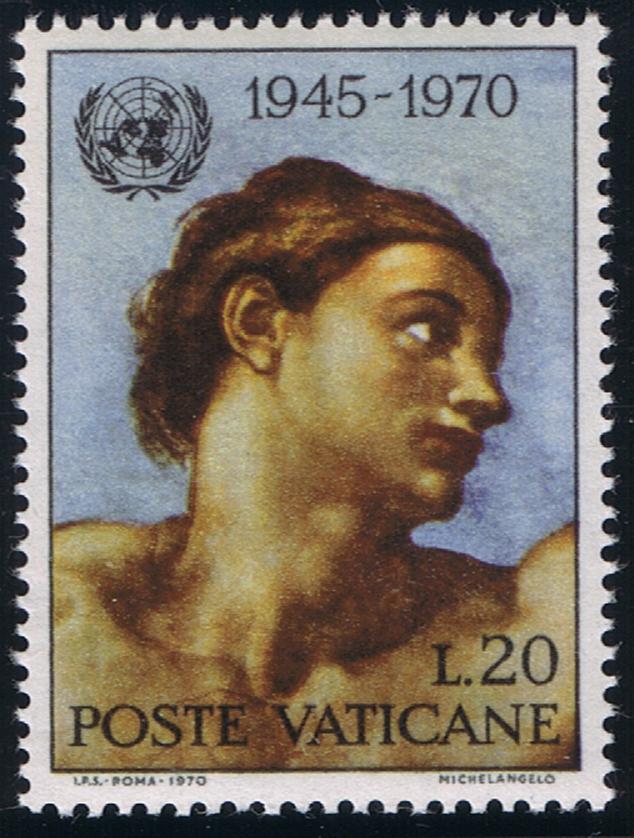
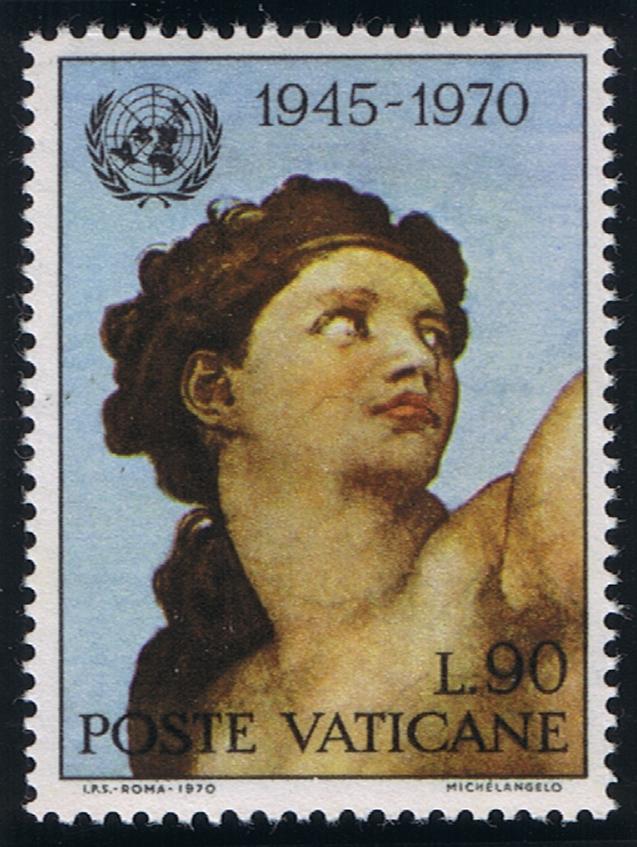
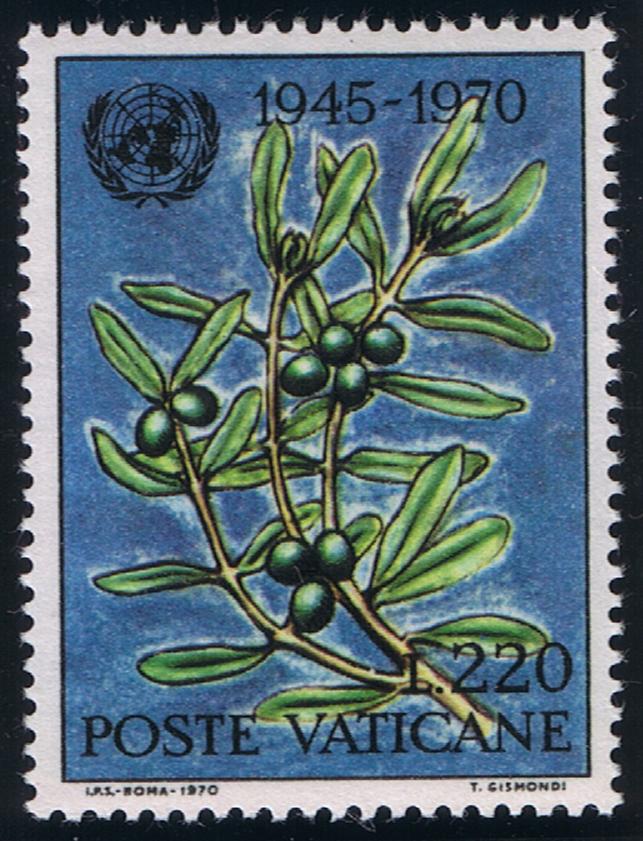
Vatican issued three stamps Oct. 8, 1970, commemorating the 25th anniversary of the founding of the United Nations. L.20 is from Michaelangelo's "Creation of Adam" on the ceiling of the Sistine Chapel. L.90 is the head of Eve from the "Fall of Adam and Eve" by Michaelangelo on the ceiling of the Sistine Chapel. (Cf. Vatican Notes Vo. XV, 01, pp.2-4). These two subjects signify the unity of the human race in its common origin, Adam and Eve. L. 220, an olive branch, symbolic of peace, the purpose of the UN. A special FD cancel consists of a single circle with ONU (UN) at the top with the UN symbol, the dates 1945 1970 indicating the 25th anniversary. The date 8-X-70 indicates the date of the First Day (prima die), and Poste Citta Del Vaticano, indicates the country of origin. On Oct. 24, 1945, in San Francisco, the following nations signed the UN Charter: Argentina, Brazil, Byelorussian SSR, Chile, China, Cuba, Czechoslovakia, Denmark, Dominican Rep., France, Haiti, Iran, Lebanon, Luxembourg, New Zealand, Nicaragua, Paraguay, Philippines, Poland, Saudi Arabia, Syria, Turkey, Ukrainian SSR, USSR, United Arab Rep., United Kingdom, USA, and Yugoslavia. Later in 1945 other signatories were: Australia, Belgium, Bolivia, Canada, Colombia, Costa Rica, Ecuador, Ethiopia, Greece, Guatemala, India, Liberia, Mexico, Netherlands, Norway, Panama, Peru, South Africa, Uruguay and Venezuela. As of this date, there are 126 members of the UN. The history of development of the UN is as follows. On Aug. 14, 1941, the United States and the United Kingdom agreed on basic principles called the Atlantic Charter. Twenty-six nations opposing the Axis in WW II accepted the Atlantic Charter, using the words "United Nations" on Jan. 1. 1942. In the Moscow Declaration of Oct. 30, 1943, the USSR, China, the USA and the UK agreed to set up an international organization to keep world peace. At Dunbarton Oaks Conference, the same four nations outlined preliminary proposals for such an organization, Aug-Oct.. 1944. Fifty nations attended the San Francisco Conference, April-June 1945, drafting and adopting the UN Charter on June 26. Poland, unable to attend, signed later, becoming a charter member. On Oct. 24, 1945, a majority of the nations ratified the Charter, so Oct. 24 is celebrated as United Nations Day. The Charter sets as purposes: to maintain world peace and security; to develop friendly relations between nations; to achieve world cooperation in solving international economic, social, cultural or humanitarian problems; encourage respect for human rights and fundamental freedoms for all; to be a center for the actions of nations to attain these common ends. Seven principles bind all signatories:- All members are sovereign and equal. They fulfill UN obligations in good faith. They will settle international disputes peacefully. They will refrain from the threat or use of force. They will give every assistance to the UN. The UN will assure that non-UN members act in accord with the Charter. The UN will not interfere with the internal affairs of any country. To implement the purposes of the United Nations, six organizations were formed: The General Assembly; the Security Council; the Economic and Social Council; the Trusteeship Council; the International Court of Justice; the Secretariat. The General Assembly: Can discuss any questions mentioned in the UN Charter or related to the powers of functions of any of the UN organs. Each nation has one vote, two-thirds required to pass a measure. The Security Council: responsible for keeping international peace. Five permanent members (China, France, USSR, USA and UK) with ten non-permanent members, elected by the General Assembly for two: years, each have one vote, nine needed to pass a measure. The Economic and Social Council: directs and coordinates economic and social work of the UN and its related agencies. Vote by majority. The Trusteeship Council: administers and supervises Territories placed under it.. Terms have been approved by the General Assembly; or in strategic areas, by the Security Council. Composed of members administering Trust Territories; permanent members of the Security Council not administering such territories, and as many members, elected for three years, as the General Assembly thinks necessary. The International Court of Justice: sitting at the Hague, Netherlands, judges inter-national matters referred to it. The Secretariat: performs the administrative functions of the UN, headed by the Secretary-General, who is appointed by the General Assembly on the recommendation of the Security Council. (Trygve Lie, Dag Hammarskjold, U Thant). Headquarters of some UN Agencies:-Geneva, Switzerland:- Un Conference on Trade Development (UNCTAD); International Labor Organization (ILO); World Health Organization (WHOI; International Telecommunications Union (ITU); World Meteorological Organization (WMO); General Agreement on Tariffs and Trade (GATT). Berne, Switzerland: Universal Postal Union (UPU). Vienna, Austria: International Atomic Energy Commission (LAEA). Rome, Italy: Food and Agricultural Organization (FAO). Paris, France: U.1 Educational, Scientific and Cultural Organization (UNESCO). Montreal, Canada: International Civil Aviation Organization (ICAO). London, U.K.: Inter-Governmental Maritime Consultative Organization (IMCO) Washington, D.C.: International Bank for Reconstruction and Development (BANK); International Finance Corporation (IFC); International Development Association (IDA), International Monetary Fund (FUND). |
| (From Vatican Notes Volume XIX, Number 4, January - February 1971, Pages 2-3) |