Home
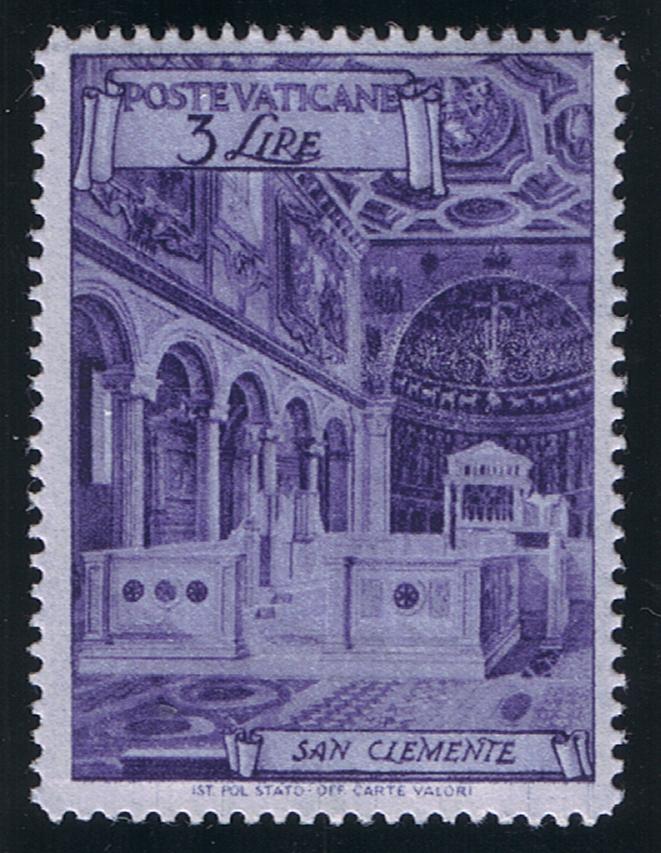
St. Clement (ca. 91 – ca. 101) is the fourth pope and the third successor of St. Peter. His name is cited in the Roman Canon of the Mass. St. Jerome and Tertullian suggest he was consecrated by St. Peter. St. Iraneaus (c. 180) writes that “having seen and conversed with the Apostles, Clement was a repository of their teaching and tradition.” Writers such as Jerome, Origen, and Eusebius suggest he was the “Clement” mentioned by St. Paul in Philippians 4:3. Some legends identify Clement with Titus Flavius Clemens, a cousin of Emperor Domitian (81-96) which is likely incorrect. It is possible he was a freedman in the Clemen’s household. The Basilica of San Clemente al Laterano is located on the Via Libicana 95, not far from the Roman Colosseum and is named after St. Clement. It is a basilica well-worth visiting. The building contains three significant levels: the current (top floor) church which is an 11th century structure (later renovated). Below it is a 4th century basilica with some remarkable 9th century frescoes depicting the life of St. Clement (reproduced on Vatican City postal cards). The third level is a first century Roman villa destroyed in the fire of 64 associated with Nero. Claims that the site of the basilica is the site of Pope Clement’s home are likely inaccurate. A second-century room contains an altar associated with Mithras, an eastern mystery cult brought back to Rome by soldiers. The lower levels of the basilica were excavated in the 19th century by Irish Dominicans who have charge of the church. It is believed that Pope Clement was sent as a prisoner to the Crimean mines during the reign of Trajan (98-117). He ministered to his fellow-prisoners and was martyred by drowning in the Sea of Azov with an anchor around his neck (an anchor is a symbol associated with Clement). Ss. Cyril and Methodius recovered Clement’s relics and the anchor during their missionary journeys in 861 and brought them to Rome in 868. A 2007 Vatican City postal card contains a 9th century fresco of the translation of his relics to Rome. The remains were enshrined at the Basilica, as were St. Cyril who died in 869 (but they disappeared during the French occupation of Rome after 1796). Pope St. Clement is considered the author of the First Epistle of Clement, a document sent to the church at Corinth. Dissension had erupted in Corinth and Clement addressed the orderly process by which bishops and deacons are appointed, tracing the concept back to Jesus appointment of the Apostles. This is an example of the leader of the church in Rome intervening in the affairs of a church outside Rome, the ‘first encyclical” as suggested by Pope Benedict XVI, showing care of by the Roman pontiff for other churches. The Basilica of San Clemente website is http://basilicasanclemente.com/eng/ and contains interesting views and commentary about the church’s history from the 1st to 21st centuries. References: • J. N. D. Kelly, St. Clement I, in Oxford Dictionary of Popes • Pope Benedict XVI, “St. Clement, Bishop of Rome,” General Audience, 7 March 2007 • In Church Fathers from Clement of Rome to Augustine, (San Francisco: 2008), Chapter 1 Article Links: • James C. Hamilton, “The Roman Basilica of San Clemente: Medieval Frescoes Revealed in Stamps and Postal Cards” Vatican Notes, Vol.58, No. 346 pp. 4-10 (2010) | |||||||