Home
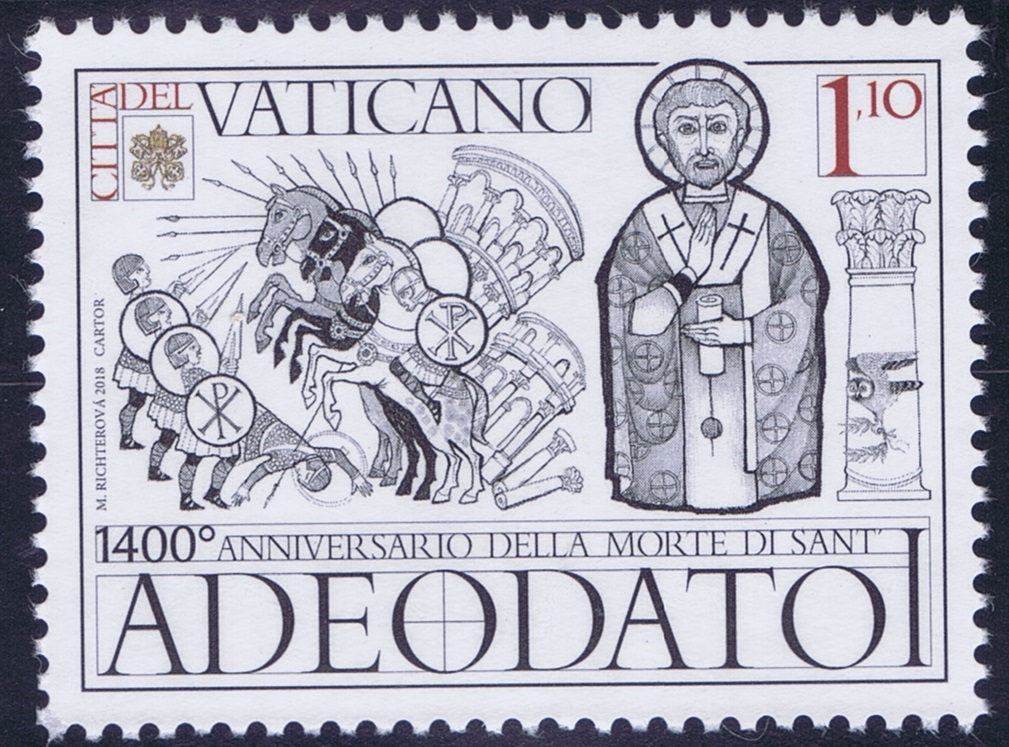
 St Adeodato I & St Zosimus Scott 1697-1698 (2018) Zosimus (or Zosimo in Italian) served as the 41st pope from 18 March 417 to 26 December 418. He was of Greek descent, perhaps Jewish, who had been recommended to his predecessor, Innocent I (401-417) by John Chrysostom (c. 347-407), then Archbishop of Constantinople, one of the greatest homilists in the history of Christianity. Pope Zosimus has received ‘negative press’ from commentators. A rather dense account in the 1912 online Catholic Encyclopedia appears to be a source used by historian J. N. D. Kelly who observes: “Although he [Zosimus] tirelessly upheld the papal claims, his short and turbulent reign was marred by blunders springing up from insufficient knowledge of the west as from his impulsive temperament and high-handed methods.”For example, he clashed with bishops in Gaul and Dalmatia over election irregularities. The issues were under what circumstances should any issues be appealed to Rome which, of course, placed final authority in Rome. Zosimus also involved himself in the controversy surrounding the Pelagian heresy. The British monk Pelagius (ca. 355-ca. 420) taught that infants were born blameless without sin. Original sin did not taint human nature and man’s free will allowed the achievement of perfection without divine grace, heretical views condemned by St. Augustine (354-430) and also at the Council of Carthage (418). At a meeting at San Clemente in Rome, Zosimus argued that those who supported Pelagianism had been exonerated, which led to a rebuke from Christian bishops in North Africa. Eventually, Zosimus backed down and anathematized those who promoted Pelagianism. Zosimus also clashed with African bishops over autonomy issues regarding the discipline of a disgruntled priest who appealed to Rome. It is suggested that he issued a decree that priests not enter Roman taverns and that deacons wear a maniple, the strip hanging from the left arm, while vested and assisting at Mass. Zosimus died after a protracted illness on 26 December as groups formed at the exarch’s court in Ravenna and in Rome in opposition to Zosimus. Historian Kelly suggests that the factionalism that erupted after his death was due in good part to Zosimus’ divisive rule. Yet, while the early 5th century might be seen as tumultuous, less than 25 years later Pope St. Leo I (440-461) emerged as a powerful voice in defense of orthodox belief, the authority of the papal office, and a defender of Rome. However, commentators such as Dawn Marie Beutner are less critical, citing that he was cautious and sometimes merciful to those who opposed him, while also facing invasions of Europe (by the Huns and others). The Vatican Notes article link below, by Michael Lamothe, explains artist Maria Richterova’s imagery for the 2018 Zosimus stamp for an alternative view of Zosimus and his era. Her design includes three columns--Egyptian, Byzantine (Constantinople), and Corinthian (Greece)--for the areas in which Christianity was flourishing in the 5th century. She also shows Pope Zosimus with a goldfinch, a symbol of Christ, and recognition of his authority. Her design avoids the complex political and religious turmoil of the age. As referenced above, St. Zosimus is depicted on one of two stamps designed by Marina Richterova in 2018. The second stamp was for St. Adeodato I, (or Deuisdedit, 615-618), whose anniversary was marked on 8 November. REFERENCES: Technical Details: Scott Catalogue - 1697-1698 Date Issued - 09 November 2018 Face Value - €1,15, €1,15 Perforations - 13x13.25 Printing Process - Offset Printer - Cartor (France) Max Printed - 60,000 |