Home

 
 Vatican City stamps featuring Saint Mark: "Saint Mark in Storm", Scott 518 (1972) Basilica of Saint Mark, Venice, Scott 520 (1972) From the Evangelists Airmail Set, Scott C56 (1971) Evangelists Vending Machine Set, Scott V12 (2002) The feast day of Saint Mark the Evangelist is celebrated on April 25. He is held to be the author of the Gospel of St. Mark, often said to be the oldest of the Gospels. The dates associated with Saint Mark include his birth, believed to be around the year 12 AD, according to Coptic tradition in Cyrene, Crete and Cyrenaica, Roman Empire. He is said to have been martyred on 23 April, 68 AD in Alexandria, Egypt, Roman Empire. After the Resurrection, Mark encountered Saint Peter (following Peter's escape from Jerusalem in the year 41 AD), and served as his interpreter as they proceeded to Rome. Through Peter, it is held that he recorded accounts of the teachings of Jesus Christ. By tradition, after the Council of Jerusalem, around 48 AD, Mark is said to have traveled to Egypt and established the episcopal see of Alexandria, one of the five most important sees of early Christianity. There is also some confusion about who Mark was. He is sometimes considered to be John Mark, another figure in Christianity’s first years. According to the Book of Acts, John Mark accompanied Barnabas to Cyprus. Another connection is that Mark was the "naked young man" who ran from the crowd when Jesus was arrested. This account appears only in the Gospel of Mark (Mark 14:51-52), and has fueled speculation that the "young man" is indeed the author of the Gospel himself. 
 West Facade of the Basilica of Saint Mark, Venice and Detail of Statue of Saint Mark atop the Basilica Photos from Wikimedia Commons (see References for attributions) In 828, St. Mark’s relics were stolen from Alexandria by Venetian merchants, assisted by Greek Orthodox monks, and transferred to Venice. To escape the Muslim guards, the relics were hidden under pork and cabbage leaves to prevent discovery, since the guards would not touch pork. The relics were interred in St. Mark’s Basilica when it was re-constructed in the 11th century and remain there today under the central altar. His symbol is a winged lion, a design also featured as a symbol of Venice: 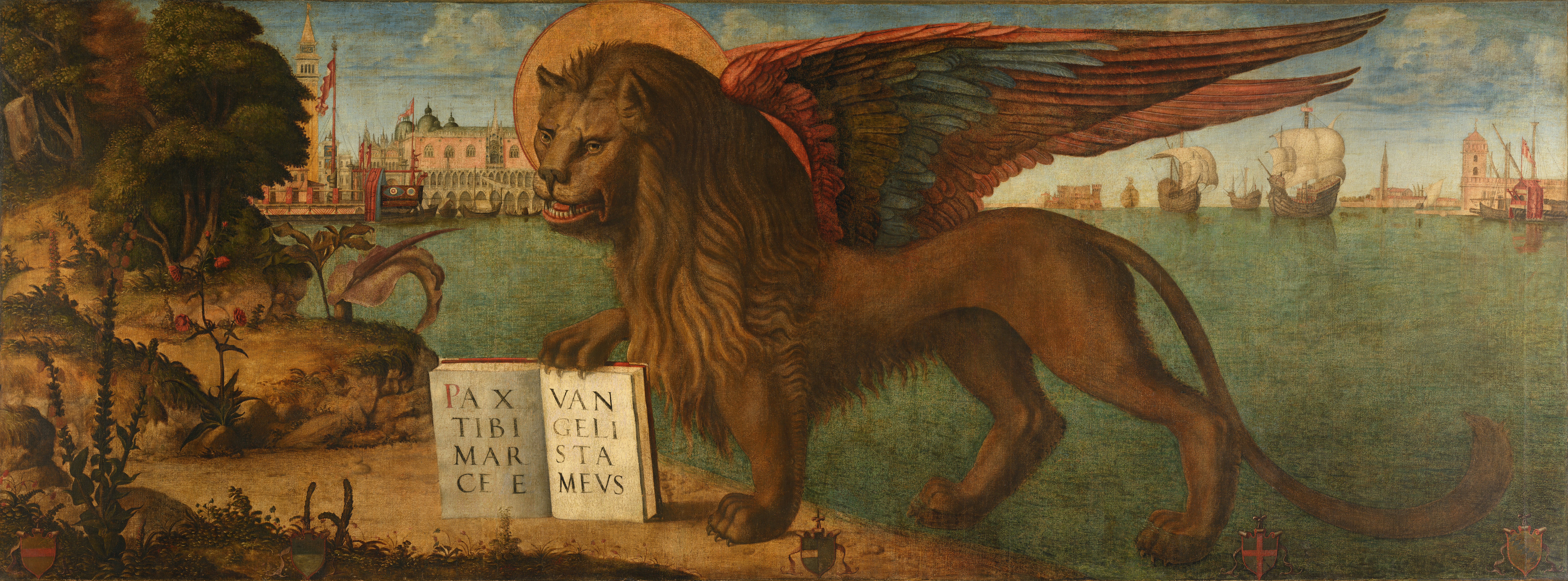 "The Lion of St Mark", by Vittore Carpaccio (c. 1516) Doge's Palace, Venice Italy From Wikipedia, In the Public Domain The inscription on the painting reads: PAX TIBI MARCE EVANGELISTA MEVS ('Peace be upon you, Mark, my evangelist'). REFERENCES: |