Home
An obelisk is a stone rectangular pillar with a tapered top forming a pyramid ion, set on a base, erected to commemorate an individual or event. There are 13 such monuments in Rome that make up its ancient history. One of the best known is the Vatican obelisk that now stands in St Peter’s Square. It is the second largest with a height of 84 feet, 135 feet with the base and weighs over 330 tons. It stands on a base 27 feet wide. Only the Roman obelisk of St John Lateran is taller. The Vatican obelisk was built in Heliopolis, Egypt in 1835BC to honor the sun, thus making it the oldest obelisk in Rome. Around 37AD Emperor Caligula had the obelisk transported to Rome on a specially built ship and had it erected near the Circus of Nero on the grounds of what is now the Vatican. Legend has it that this is where many Christians, including St Peter, were put to death and for that reason this obelisk is looked upon as the last witness to the martyrdom of St Peter. 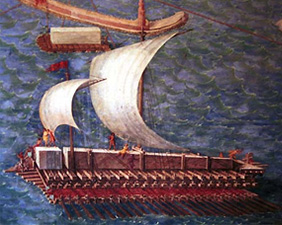 Concept Of The Ship That Sailed The Vatican Obelisk From Egypt To Rome In 37AD Pope Sixtus V had the obelisk moved 800 feet to the square by the Basilica of St Peter, where it remains today. The strenuous undertaking began in April,1586. It was the first obelisk to be re-erected in modern times. The move took four months and required 900 workmen, 75 horses and 44 winches on the day of its raising. It is said that Pope Sixtus V ordered the huge crowd of spectators to remain silent under the pain of death while the obelisk was being raised. After the successful re-erection on September 10, 1586, the chief engineer, Dimenico Fontana, was carried on the shoulders of the triumphant Romans to his home. The obelisk was placed on its base September 26, 1586.  The Vatican Obelisk In St. Peter's Square | Originally, at the top of the obelisk was a bronze sphere that was said to contain the remains of Julius Caesar. It was found to only contain dust. (That ancient metal ball is now in the Museo dei Conservatori of the Capitoline Museum in Rome.) The monument needed pagan cleansing, therefore, a large bronze cross with a relic of the true cross was placed on the top. Obelisk inscriptions on the north and south sides of the base have texts written by Cardinal Silvio Antonaini as a memorial to the moving of the obelisk. The east and west sides have exorcist formulas inscribed. The obelisk in St. Peter’s Square may have come from a pagan culture but it has been thoroughly “baptized” and now stands where it does as an expression of the conquering power of the Church. Few people know that this almost 4,000 year old obelisk is also a sundial. Its shadows mark noon over the signs of the zodiac in the white marble disks placed in the paving of the square in 1817. The obelisk rests upon four couchant lions, each with two bodies whose tails intertwine. References: • UTube, "The Secrets of the Vatican Obelisk" • Jeff Bondono, "A Tourist in Rome - Vatican Obelisk" | ||||||||||||||||||