Home
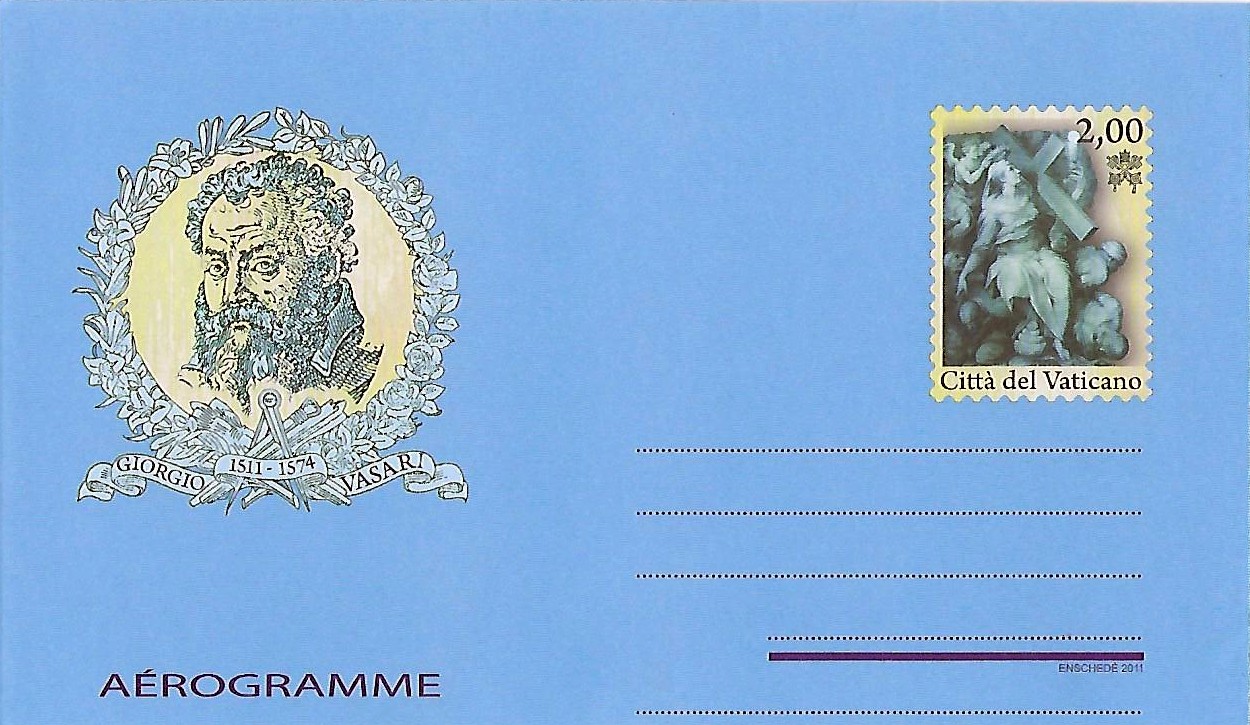 Giorgio Vasari: 5th Centenary of Birth Aerogramme of 2011 October 7 marks the Feast of Our Lady of the Rosary, a feast day tied to the great naval Battle of Lepanto in 1571. The 2011 Vatican City aerogramme, shown above, has as its postal indicia an image from a much larger painting by Giorgio Vasari entitled, “The Battle of Lepanto 7 October 1571”. Here is a presentation of Vasari's work, which is housed at Sala Regia of the Vatican Museums:  'The Battle of Lepanto' (' La battaglia di Lepanto ') by Giorgio Vasari Photograph by Sailko From Wikimedia Commons, used under the terms of the Creative Commons Attribution 3.0 Unported License On 7 October 1571, the naval fleet of the Holy League defeated the fleet of the Ottoman Empire at Lepanto, off the west coast of Greece off the Gulf of Corinth in the Ionian Sea. The Holy League was organized by Pope Pius V (1566-1572) and included the Papal States, Spain, Venice, Genoa, Malta, the Grand Duchy of Tuscany and the Duchies of Savoy, Urbino, and Parma. It was the last sea battle using rowing ships, the largest battle of the sixteenth century and, in fact, the largest sea battle in over 1,500 years. Prior to the battle, Pope Pius V asked all European faithful to pray the rosary and ask for the intercession of the Blessed Mother in aiding the Holy League.  "Battle of Lepanto" by Ignazio Danti Vatican Gallery of Maps From Wikimedia Commons, in the Public Domain The Holy League was commanded by Don Juan of Austria (1547-1578). The Christian fleet, consisting of about 210 vessels, entered the Gulf of Corinth at 2 a.m. with a favorable breeze. At dawn, the Muslim fleet, made up of around 270 ships, emerged in a crescent-shaped formation which extended from shore to shore. The Christian fleet formed as a Cross with the majority of ships in the central column. Turkish Grand Admiral Muesinsade Ali flew a green banner copied from one at Mecca carried by Mohammed with the name of Allah inscribed 29,000 times. Don Juan’s banner carried an image of the crucified Christ on a blue field which flew from his ship’s foremost mast. Historian Richard Mackenney writes that “this was not to be a battle of tactics and maneuvers. Don John aimed at achieving a breakthrough by head-on collision, victory by close fighting. There was a crucifix on every deck, and the Christians knelt at Mass in gleaming armor before battle was joined.”The resulting Christian victory was overwhelming: 8,000 Turks were killed and 10,000 captured, with close to 200 Muslim ships sunk, captured or destroyed. Christian losses totaled 7,500 killed and only 17 ships lost. Around 12,000 Christian galley slaves were liberated from the Ottoman fleet after they broke free during the engagement and assisted in turning the tide of battle. Coming after the successful defense of Malta during the 1564 siege of that island, the victory was hailed throughout Europe and temporarily checked Ottoman expansion during the long reign of Sultan Suleiman the Magnificent. The on-going threat of the Ottoman Empire did not disappear after the battle: Muslim forces would threaten Vienna for a second time in 1683 and in the Great Turkish War of 1683-1699. Pope Pius V celebrated a Mass of thanksgiving at St. Peter’s Basilica and the next year, he proclaimed Our Lady of Victory to be established as a universal permanent feast day. His successor, Pope Gregory XIII changed the name of the feast to Our Lady of the Rosary in 1573 to emphasize the rosary as the instrument of triumph. REFERENCES: |