Home
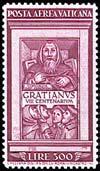
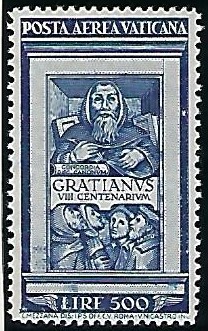 Monk Franciscus Gratianus and Four Disciples C20-C21 (1951) Franciscus Gratianus was born at the end of the 11th century at Chiusi in Tuscany. He was said to have become a monk at Camaldoli, taught at the monastery of St. Felix in Bologna, and devoted his life to studying canon law. Since the 11th century, Bologna had been the center of the study of canon law, as well as of civil law, after the Corpus Juris Civilis was rediscovered in Western Europe. Jurists and scholars who trained in this Roman law played a leading role in the creation of national legal systems throughout Europe, and the Corpus Juris Civilis thus became the ultimate model and inspiration for the legal system of virtually every continental European nation. Gratianus's work was an attempt, using early scholastic method, to solve seemingly contradictory canons from previous centuries. Gratianus quoted a great number of authorities, including the Bible, papal and conciliar legislation, church fathers such as Augustine of Hippo, and secular law in his efforts to reconcile the canons. Gratianus found a place in Dante's Paradise among the doctors of the Church, and he was long acclaimed as "Father of Canon Law". Gratianus’s 'Decretum', a collection of nearly 3,800 texts touching on all areas of church discipline and regulation, was compiled by the Benedictine monk around 1140. It soon became the basic text on which the masters of canon law lectured and commented in the universities. References: • Wikipedia, "More Detail on Gratianus's Decretum" • Bartholomew of Brescia Commentary, "Gratianus's Decretum Commentary" Article Links: • Anonymous,“The Story Behind the Stamp” : Vatican Notes, Vol. 10, No. 5 p. 5 (1962) • James C. Hamilton,“Gratian - Father of Cannon Law” : Vatican Notes, Vol. 68, No. 383 p. 28-33 (2020) |