Home
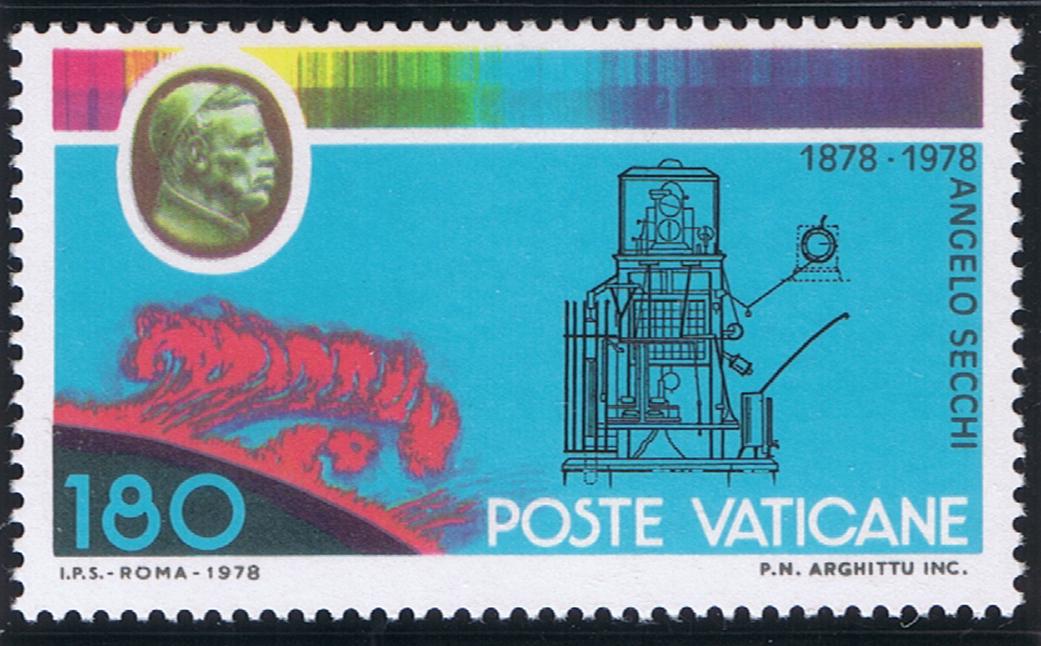
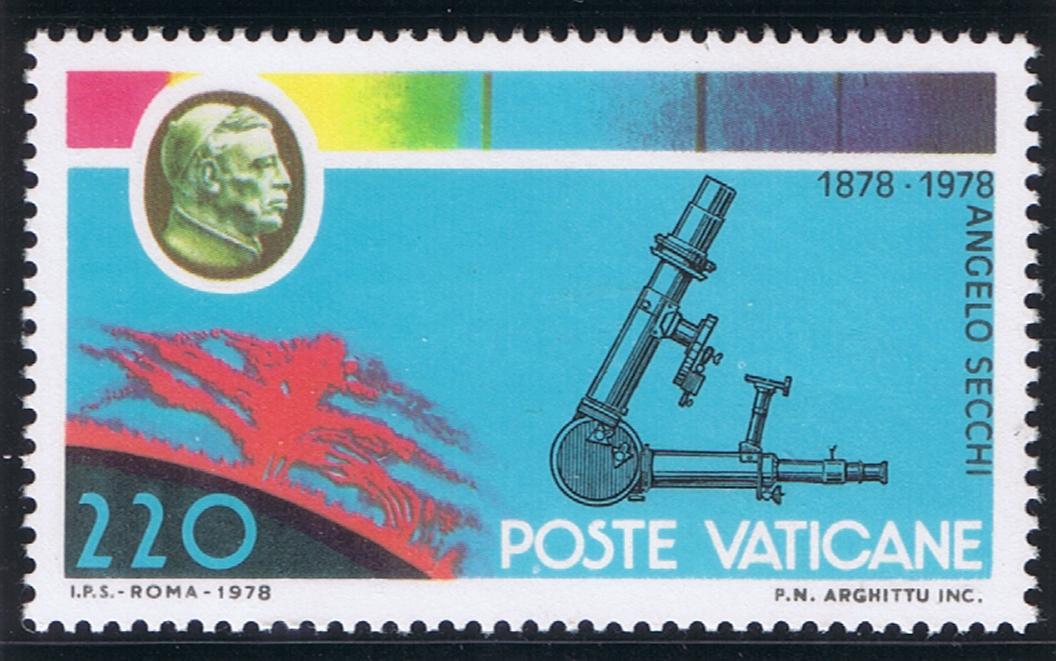
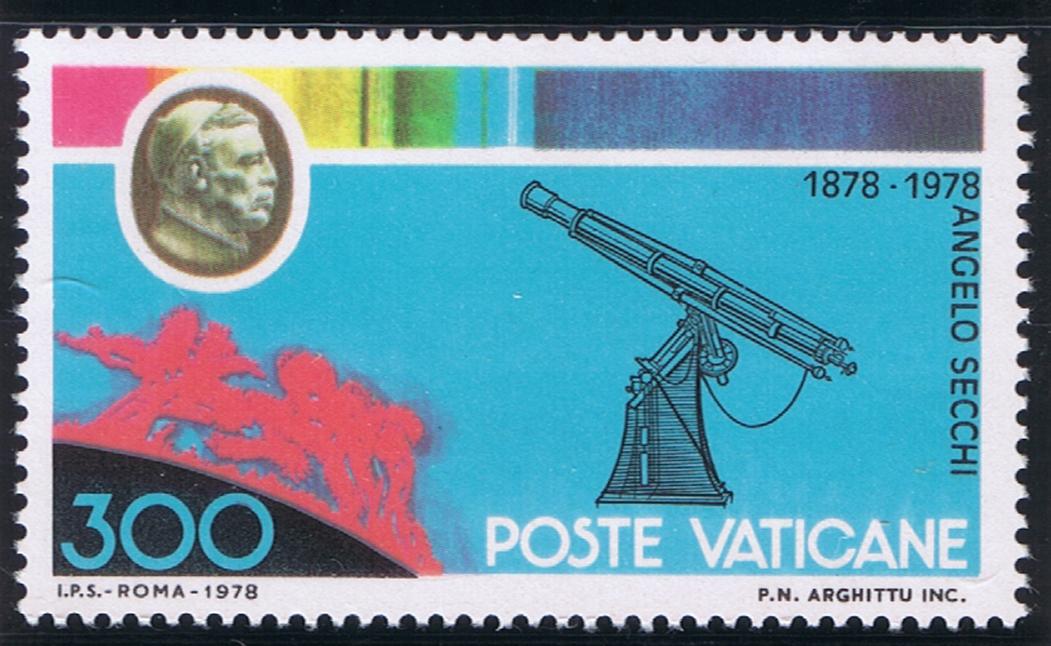 Father Angelo Secchi: Centennial of Death Scott 654-656 (1979) On June 25, 1979, Vatican City issued three stamps honoring the centennial of the death of Father Angelo Secchi. The three stamps share a similar design. Each stamp shows a profile of Father Secchi in the upper left, the visible spectrum along the top of the stamp, and depictions of solar protuberances in the bottom left corner. The individual stamps illustrate instruments used by Father Secchi in his studies. The 180 lire stamp shows the "Meteorograph" (invented by Father Secchi), the 220 lire stamp has an image of a spectroscope, and the 300 lire stamps presents a telescope. The stamps were due to be issued in 1978 (Father Secchi died on February 26, 1878), but the release was delayed due to the deaths of two popes in 1978: Popes Paul VI and John Paul I. Pietro Angelo Secchi was born on June 29, 1818, in Reggio nell’Emilia, in the duchy of Modena (now in Italy). Secchi entered the Society of Jesus in 1833. He went on to became a lecturer in physics and mathematics at the Jesuit College in Loreto, Italy. In 1844, he went to Rome to complete his theological studies and to lecture at the Roman College. When the Jesuits were expelled from Rome in 1848, Secchi went to Stonyhurst College in England, and then to Georgetown University in Washington, DC. Due to his reputation as an astronomer, he was allowed to return to Rome in 1849, where he became a professor of astronomy and the director of the observatory at the Roman College (now the Gregorian University), a role he filled for 28 years.  Observatory of the Collegio Romano (1852) From Wikimedia Commons, in the public domain Presented in the illustration above is a view of the Astronomical Observatory built under the guidance of Father Secchi at the Collegio Romano in 1852. It rested on the piers that were intended to support the dome for the Chiesa di Sant'Ignazio (Church of Saint Ignatius), which was originally the chapel for the Collegio Romano. The illustration labels the various components of the observatory (#8 marks the rear side of the church of pediment). In an interesting historical and artistic note, the dome for the Church of Saint Ignatius was never built due to a lack of funds. To overcome the deficiency, a "false dome" was painted on the ceiling of the Church to provide the illusion of a dome rising above to the heavens. From the observatory, Father Secchi carried out his research in stellar spectroscopy, terrestrial magnetism, and meteorology. His studies of the spectra of stars led to the development of his system whereby stars could be classified according to their spectral type and that stars could be arranged in four classes, based on the type of spectra they displayed. Also, based on his observations of solar phenomena, he was one of the first astronomers to state authoritatively that the Sun is a star. In addition to his work in the field of astronomy, Father Secchi also studied oceanography, meteorology, and physics. Two examples of his inventions include the Secchi disk, which is used to measure the water transparency of the oceans and other bodies of water, and the Meteorograph, used for the recording of meteorological data. In addition to the three-stamp set issued in 1979, Vatican City also issued a stamp in 2018 commemorating the 200th anniversary of Father Secchi's birth: 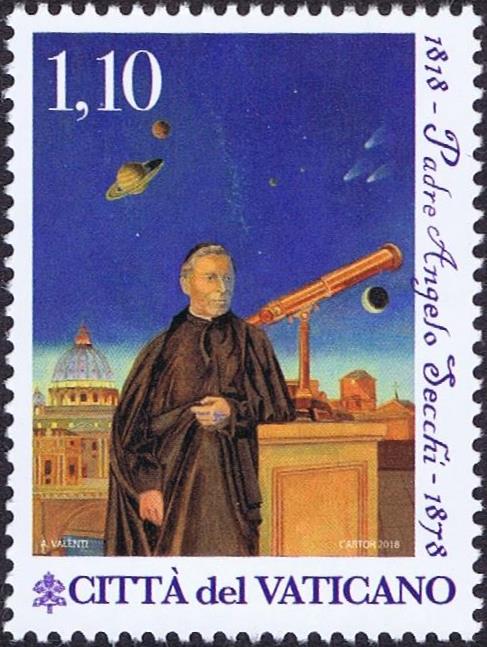 Father Angelo Secchi Scott 1691 (2018) REFERENCES: |