Home
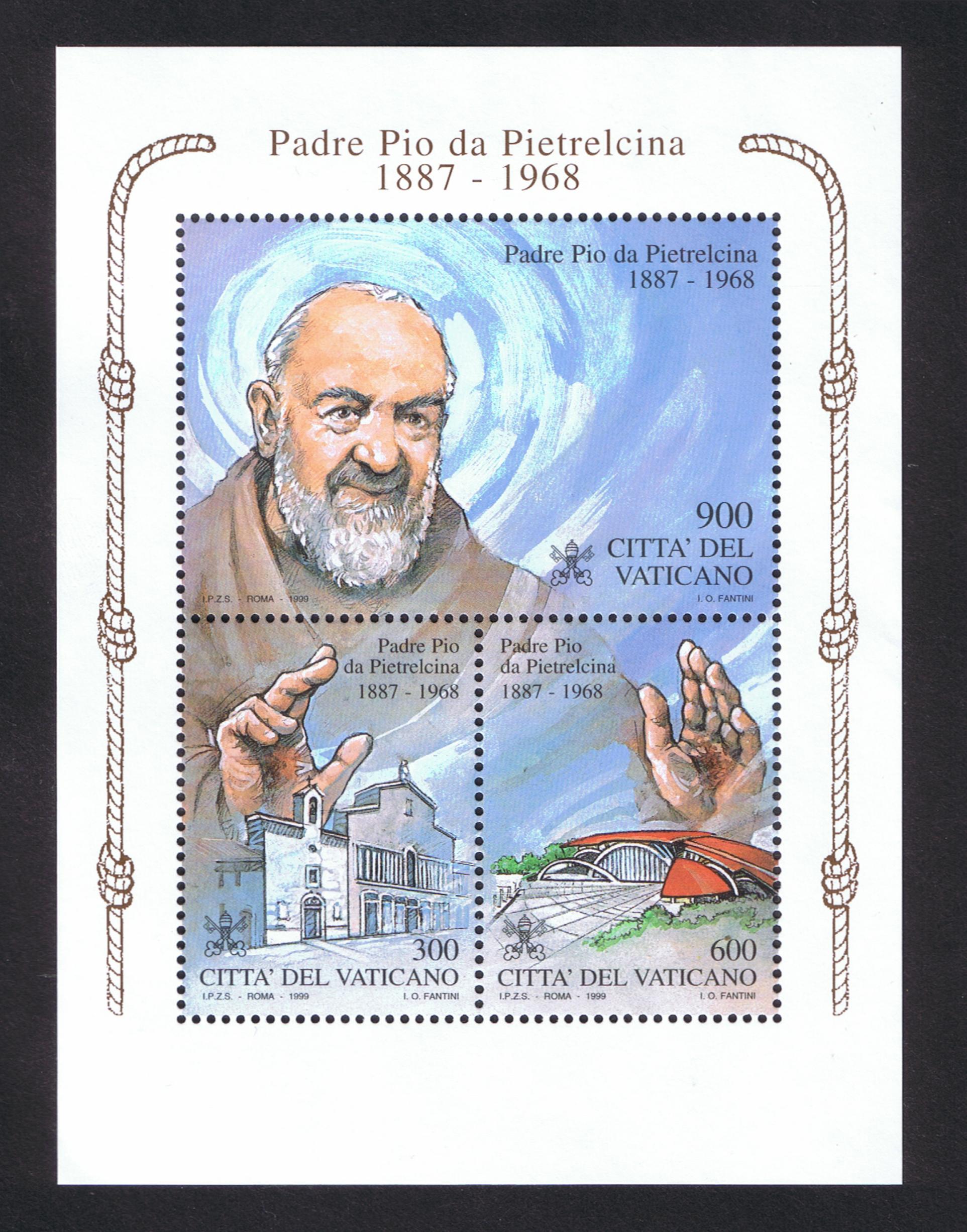 Beatification of Saint Pio of Pietrelcina Souvenir Sheet (Scott 1106, 1999) In 2023, I had the opportunity to research and write an article on Saint Pio of Pietrelcina for Vatican Notes. Affectionately known as Padre Pio, we can view Padre Pio as a rather contemporary saint, having died in 1968. He was beatified in 1999 and canonized in 2003, both by Pope Saint John Paul II, one of his great admirers. Prior to starting the article, I can say that I knew a bit about Padre Pio, but I did not have a very deep understanding of his life and what he went through over the years of his ministry. As I read more, I found myself gaining a high degree of admiration for what Padre Pio endured during his lifetime: physical and mental anguish, rejection and mistrust related to his receiving the stigmata, the long hours he spent in the confessional, and so forth. For a simple and humble man, Padre Pio had a tremendous impact and gained a huge following of believers. As a result, he has become one of the most popular saints of the Catholic Church. During my research, I came across the Saint Pio Foundation, whose mission is to: "promote the knowledge of and devotion to Saint Pio of Pietrelcina, known also as Padre Pio, one of the most venerated contemporary saints of the Catholic Church."As part of its mission, the foundation transmits five relics of Padre Pio around the country for veneration by the faithful. As I looked at the schedule for 2023, I found that the relics would be in Massachusetts in August at Saint Patrick’s Church in Falmouth (on Cape Cod), about 65 miles from my home in Quincy. I decided that I wanted to attend the veneration services. The relics of saints are classified as either first-degree, second-degree or third-degree relics. The Catholic Church defines a ‘first-degree’ relic as a body part, such as a piece of bone, flesh or blood. A ‘second-degree’ relic is an item that was a possession of the saint or something that directly touched the saint. ‘Third-degree’ relics are items that have been touched against a first- or second-degree relic. The five relics of Padre Pio brought to the veneration services included: Prior to going to the services, I watched a short presentation on the proper veneration of the relics and realized that I could bring items to the service to create third-degree relics as part of my veneration. When I arrived at Saint Patrick’s Church, the first thing I did was say my confession. In reading about Padre Pio, I learned that he spent many hours daily (sometimes 12 to 16 hours per day) hearing the confessions of people who came from far and wide to have him hear their confessions and grant his absolution. I found it appropriate that priests were stationed at the Church during the entire veneration period to hear confessions. I then was allowed to venerate the relics, touch my personal items to the relics, and contemplate my experiences. It was a very moving and emotional service. As a side note, later in 2023 the relic of Saint Jude, one of the twelve Apostles, arrived from Italy for a processional tour around North America. I was fortunate to attend a veneration service for the Saint Jude relic as well, which is a section of his arm bone encased in a reliquary. I would encourage anyone with access to veneration ceremonies to attend. REFERENCES: |