Home
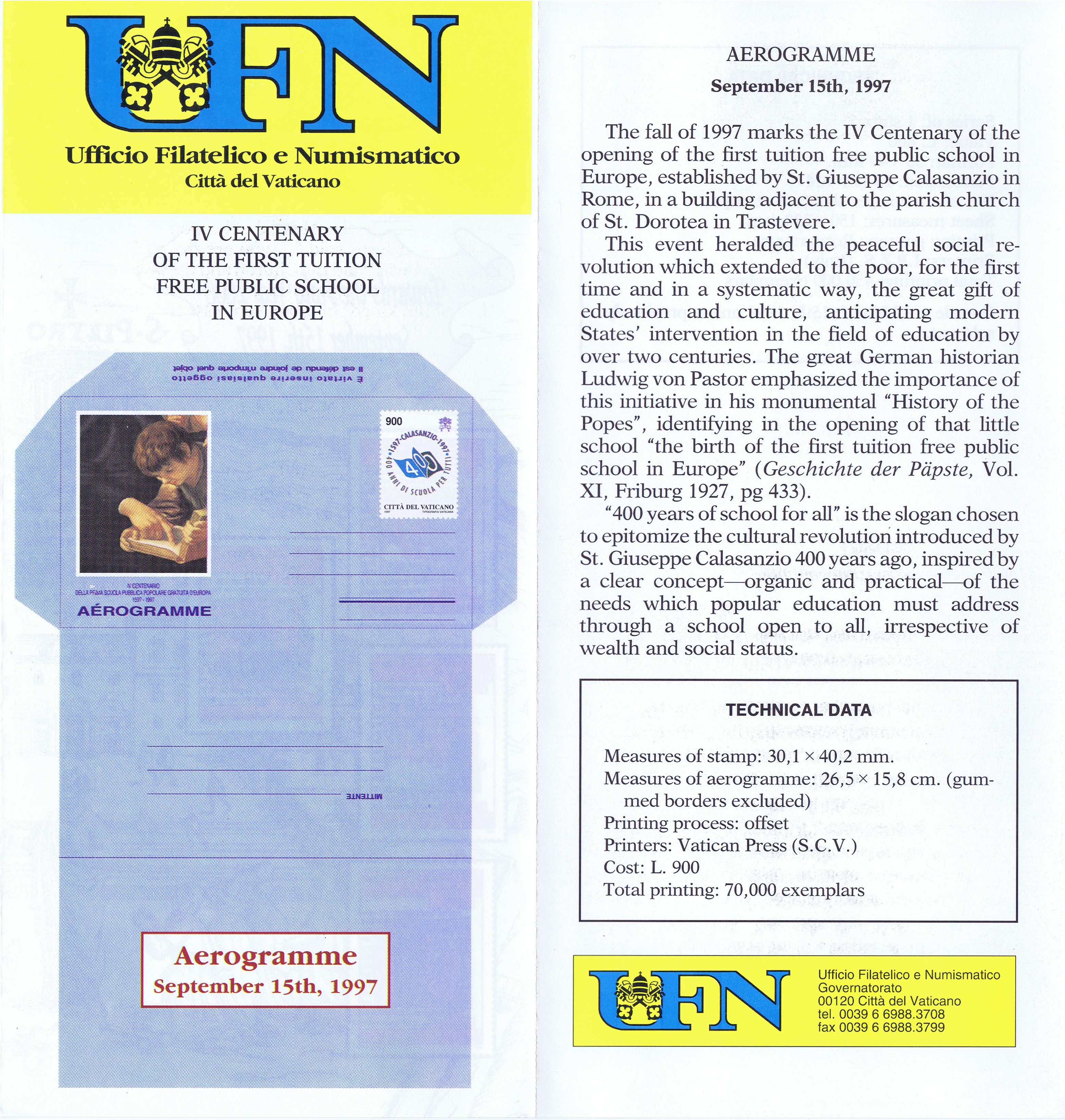
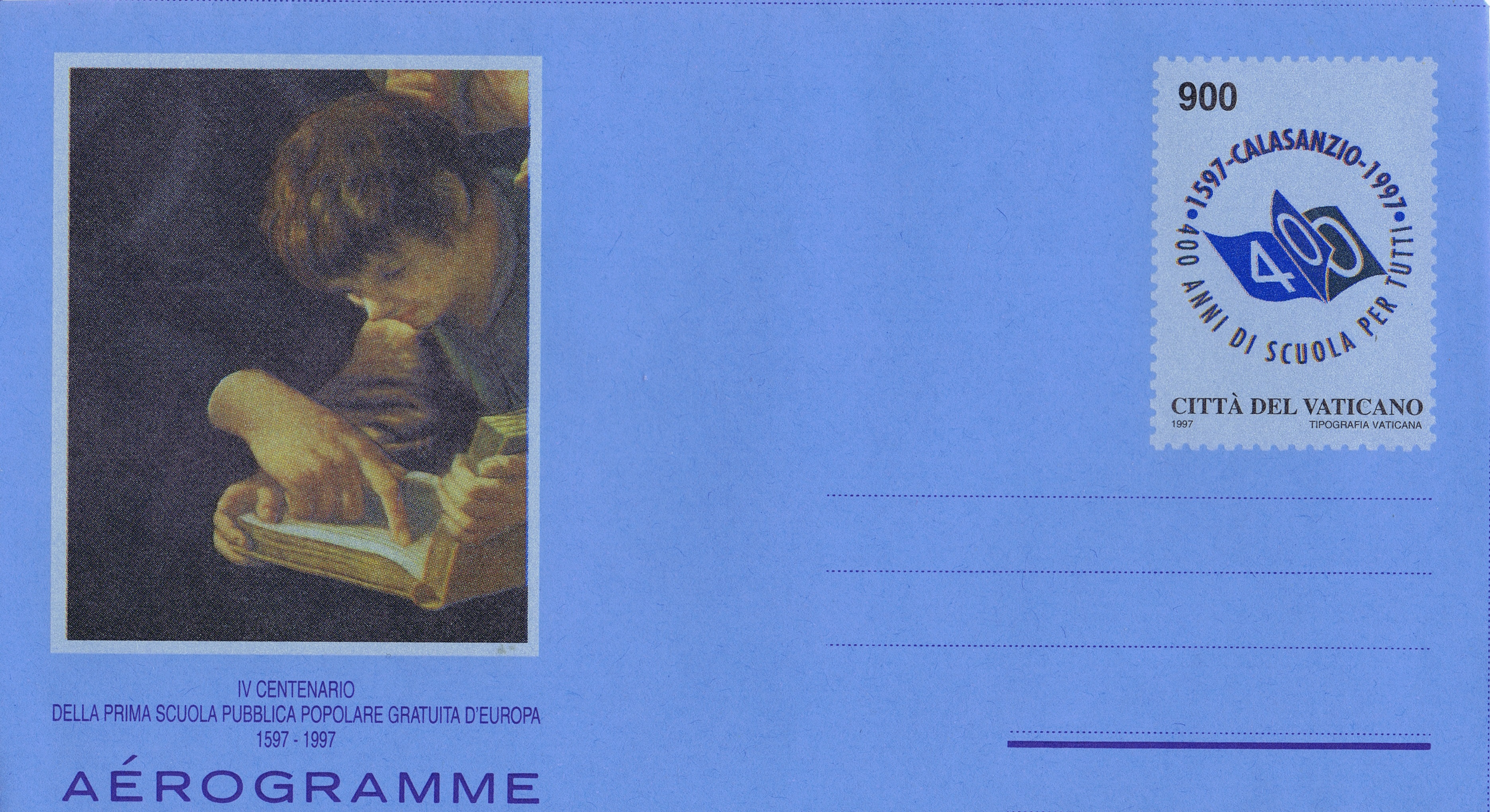 Fourth Centenary of the First Tuition Free Public School in Europe Vatican City Aerogramme, 1997 On September 15, 1997, Vatican City issued the aerogramme shown above to commemorate the 400th anniversary of the opening of the first tuition-free public school in Europe. Saint Joseph Calasanz (also known as San Giuseppe Calasanzio in Italian and San José de Calasanz in Spanish) was born on September 11, 1557, in Peralta de la Sal, Kingdom of Aragon (in present-day Spain). He was ordained as a priest in 1583 and came to Rome in 1592, becoming a member of the Confraternity of the Holy Apostles and starting his mission of visiting the poor in the the districts of Rome. He would remain in Rome for the rest of his long life.  "San José de Calasanz" Painting by Francisco Jover y Casanova (circa 1879) From Wikimedia Commons, in the Public Domain One day, he noticed a group of dirty, shabby boys playing in the streets, and he "suddenly understood the mission for which he had come to Rome from his distant homeland: the school". He gathered boys from the streets intent on providing religious and general schooling. However, he met with resistance since the existing school teachers were poorly paid and refused to accept any new students without remuneration. He approached the pastor of the Church of Santa Dorotea in the district of Trastevere, who offered to provide two rooms just off of the parish sacristy for teaching space. He also promised to assist in teaching, and two other priests also joined the effort. On November 27, 1597, he opened what is now considered the first free public school in Europe. He went on to establish additional "Pious Schools" and founded the religious order that would run the schools, commonly known as the Piarists. From these humble beginnings, a 'peaceful social revolution' began: the extension of education and culture to the masses. The actions for Father Calasanz, in some quarters, were met with opposition. Formal education, until that time, had been reserved for the rich and privileged. His concepts aroused opposition in the governing classes in society, as well as the ecclesiastical hierarchy. Due to "outside intrigue and pressure", Father Calasanz was briefly held and interrogated by the Inquisition in the mid-1600's, and the Piarist Order was briefly suppressed. Joseph Calasanz died in Rome at age 90 on August 25, 1648. He was beatified on August 7, 1748 by Pope Benedict XIV, and canonized on July 16, 1767 by Pope Clement XIII. And, on August 13, 1948, Pope Pius XII declared him to be the "Universal Patron of all Christian popular schools in the world". His relics are conserved in a devotional chapel in the Piarist motherhouse in Rome, located at the Chiesa di San Pantaleo. His feast day is celebrated on the anniversary of his death, August 25. It can be said that the works of Saint Joseph Calasanz presaged the intervention of the state in providing free education by over 200 years. As stated by famed historian Ludvig von Pastor in his epic work History of the Popes, the opening of the Pious Schools represented "the birth of the first tuition free public schools in Europe". The link to the Vatican Notes article below provides some of the technical details on the aerogramme, as presented by Thomas Crimando in his 'New Issues' article from January, 1998. The postal indicium on the aerogramme, denominated at 900 lira, features a design with a stylized number "400" surrounded by the words: "1597-Calasanzio-1997: 400 Years of School for All". REFERENCES: |