Home
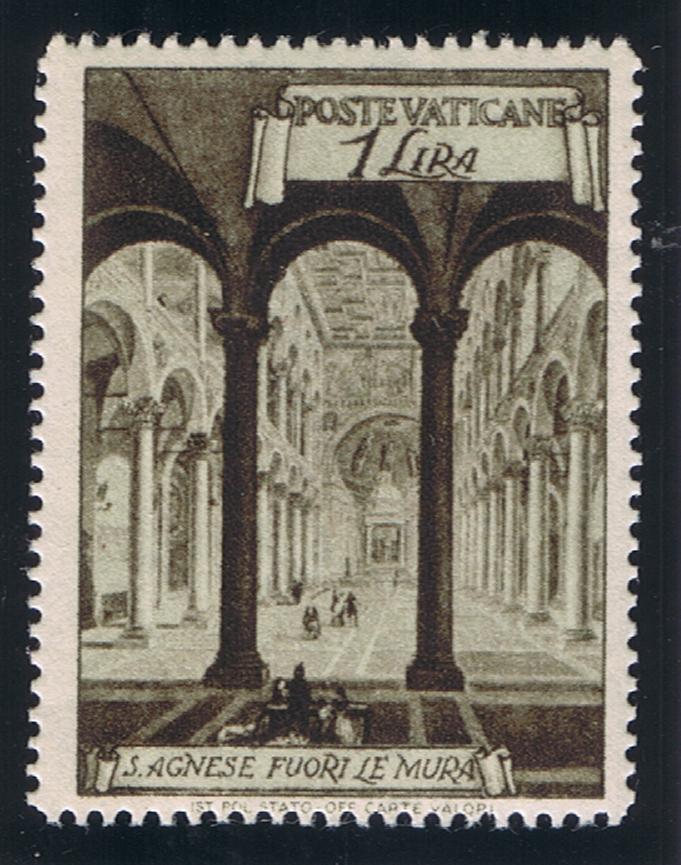
January 21st is the feast day of Saint Agnes. She died around 305 AD and is one of the more well-known virgin martyrs of Rome. In the 350s a basilica was built over her grave on the Via Nomentana. Today, the basilica that bears her name is one of the more frequently visited ancient Roman churches. The Basilica of Saint Agnes is represented on one of the stamps from the Roman Basilicas Series of 1949 (shown above). There are few specific details known about Saint Agnes. In the 5th-century compilation of acts of the early martyrs, Saint Agnes is described as a 12 or 13-year-old consecrated virgin, a symbol of purity, dedicated to Christ. She refused marriage, preferring death, and, during the Diocletian persecutions, her throat was pierced by a sword, a common Roman method of execution. Saint Agnes is usually represented with a lamb, as seen in a sixth-century mosaic at San Apollinare Nuove at Ravenna, as well as in other religious art. Her name resembles that of agnus (lamb). On her feast day, lambs are blessed (often by a pope) and their wool is used to weave the pallia worn by archbishops. TEXT FROM DAILY QUERSTION: Answer: St. Agnes was martyred as part of the persecutions of Diocletian (emperor 284-305) about the year 304. Tradition has it that one night the daughter of Constantine (emperor 306-337), Constantia, went to the tomb of St. Agnes to pray for relief from a skin ailment. The next morning when Constantia woke up the issue with her skin had been cured. Constantia attributed this sudden cure to her prayers to St. Agnes. In gratitude, Constantia had a church built on the site of St. Agnes's tomb. REFERENCE Pope Leo XIV presented with lambs on feast of St. Agnes, January 21, 2026 https://www.vaticannews.va/en/pope/news/2026-01/pope-leo-xiv-sheep-st-agnes-tradition-palliums-archbishops-rome.html |