Home

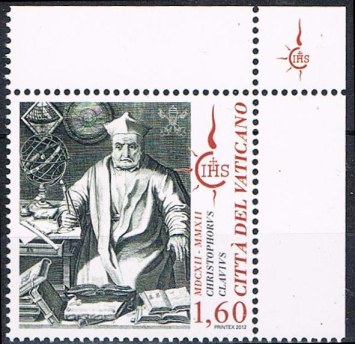
 Famous Mathematicians on Vatican City Stamps: Rugerius Boscovich, Scott 1482 (2011) Christopher Clavius, Scott 1494 (2012) Maria Gaetana Agnesi, Scott 1692 (2018) On June 19, 2023, Pope Francis issued the Apostolic Letter Sublimitas et Miseria Hominis (The Grandeur and Misery of Man). The issuance of the letter coincided with the 400th anniversary of the birth of Blaise Pascal, the 17th century French physicist, mathematician and Catholic philosopher. Born in 1623, Pascal was recognized as a child prodigy in mathematics. His earliest works focused on the study of conic sections, and at age 16 he wrote a treatise on the subject of projective geometry. He communicated with Pierre de Fermat on probability theory, strongly influencing the development of modern economics and social science. At age 19, he started some pioneering work on calculating machines, known as Pascal's calculators, making him one of the first inventors of the mechanical calculator. He also influenced the development of the 'Carosses a Cinq Sous', or 'Five-Penny Coaches", the world's first public transit system, which began in 1662. His influence on Catholic thinking centers on a conversion he experienced at age 31, which he referred to as the Night of Fire, and from this he developed thoughts on the role of reason in religious belief. In his Letter, Pope Francis states that Pascal argued for the reasonableness of faith in God. Pascal also recognized reason’s limits and stressed the importance of responding with faith to God’s call. In poor health for most of his life, Pascal died at the young age of 39. Pope Francis reminded the reader of Pascal’s attention to the less fortunate, as he was quoted as saying on his deathbed: If the physicians tell the truth, and God grants that I recover from this sickness, I am resolved to have no other work or occupation for the rest of my life except to serve the poor.Pope Francis adds: It is moving to realize that in the last days of his life, so great a genius as Blaise Pascal saw nothing more pressing than the need to devote his energies to works of mercy.It is interesting that Pope Francis, the first Jesuit pope, is a long-time admirer of Pascal in light of the fact that Pascal was a strong opponent of the Jesuits. Despite his association with the Jansenist movement in 17th century France, Pascal has been labeled as ‘perfectly Catholic’ and as a ‘beacon’ of faith who brings together ‘science and faith, philosophy and mathematics [and] spirituality and a practical mindset’. Given the pope’s admiration for Pascal and this year’s release of Sublimitas et Miseria Hominis, it is surprising that Vatican City did not issue a stamp in 2023 to commemorate the 4th centennial of Pascal’s birth. Other countries have issued stamps over the years to honor Pascal, including France, Monaco, the Czech Republic and North Macedonia, among others. Vatican City has released stamps depicting other mathematicians, including Ruderius Boscovich (Scott 1482, from 2011), Father Christopher Clavius (Scott 1494, from 2012) and Maria Gaetana Agnesi (Scott 1692, from 2018), all of which are shown above. REFERENCES: |