Home

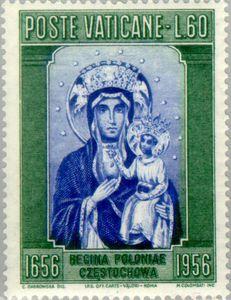

On December 20, 1956, Vatican City issued a three stamp set celebrating the 300th anniversary of the proclamation of the Madonna of Czestochowa as the “Queen of Poland”. The stamps are based on the iconic painting of the Madonna shown here: 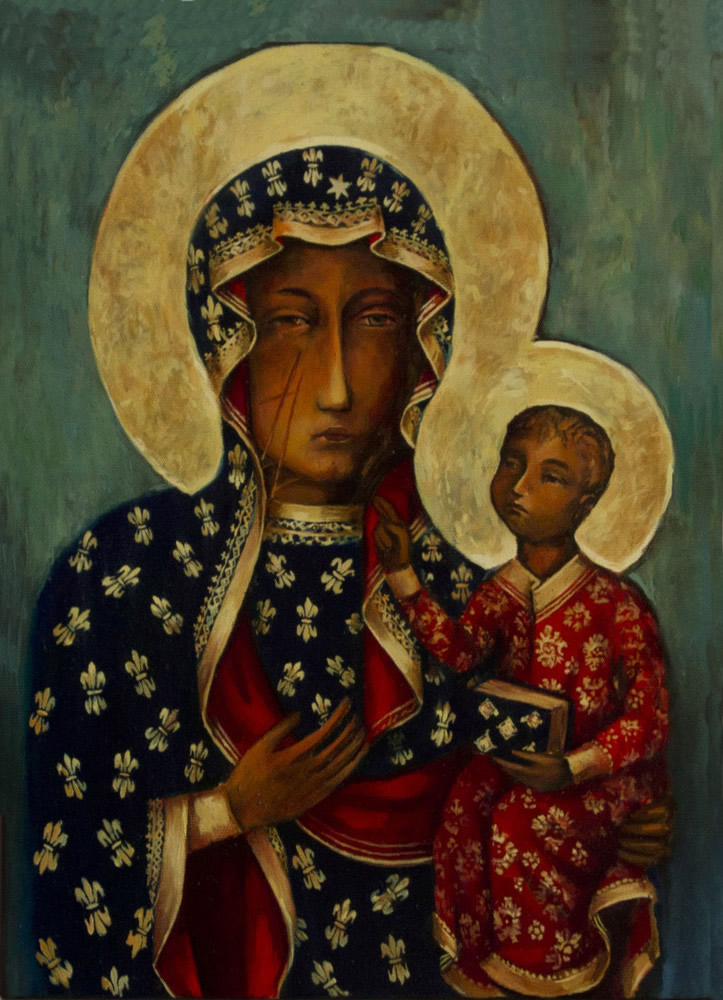 The Black Madonna of Czestochowa Jasna Góra Monastery Częstochowa, Poland From Wikimedia Commons (In the public domain) There are no concrete facts known about this picture prior to 1382, but popular legend gives us the following story. Our Lord Jesus Christ had learned the trade of carpentry from his father, St. Joseph, and built a table for his mother at their home in Nazareth. After the death of Christ Mary, as directed by her Son, went to live with St. John, and her household belongings went with her. While St. Luke was learning from the Blessed Mother the story of the infancy of Christ, at the insistence of a group of women, he paintedon the table a portrait of the Mother and Child. This group of women formed the first religious community of women in the Church and, after the death and assumption of the Blessed Virgin, they kept the portrait in their community, bringing it to the town of Pella to escape the destruction which was wrought on Jerusalem in 70 A.D. It was preserved in the east until 326 when St. Helena, mother of Constantine the Great, came to the Holy Land seeking relics of the Holy Places. Constantine was, at this time, building the new Rome of the East, Constantinople, whose patroness was the Mother of God. To this city the painting was brought and placed in a church especially built for it, and to many who prayed at the shrine there came great graces and many miracles. At one time the picture was carried in procession and saved the city from assault and capture. It remained in Constantinople for 500 years The painting escape the iconclasm of Leo the Issurian, because the Empress Irene concealing it in the imperial palace, and it was handed down from Empress to Empress. Soon the female side of the imperial family received it as part of their marriage dowry. Through the inter-marriage of the Imperial Family and Russian Nobility the painting came, as a dowry, to Russia and eventually to the Castle of Belzki, where it remained for 500 years. In the expansion of Poland, under Casimir the Great, the Castle of Belzki came under Polish rule and eventually under King Ladislaus. When he ascended to the throne, he had to recapture the Castle of Belzki, and his first public act, on occupying the castle, was to give honor to the miraculous painting. Shortly afterwards the Tartars besiged the castle and, in the fight, an arrow entered the chapel through a window and struck the painting, leaving a scar on the throat of the Virgin. This angered the defenders so that they overwhelmed the Tartars. King Ladislaus decided to take the sacred painting to his birthplace, Opala in Upper Silesia, and while traveling there spent the night in Czestochowa and placed the painting in the Church of the Assumption for the night. In the morning the painting was placed in a wagon to continue the journey but the horses refused to move. Ladislaus prayed before the painting for enlightenment and twice, in his dreams, was directed to leave the painting in Czestochowa on Jasna Gora. On August 26, 1382, the picture was carried in procession into the Church of the Assumption. Ladislaus ordered the erection of a church, convent and cloister on Jasna Gora, and brought to Poland some Pauline priest from the convent of Nosztre, Hungary, and to these monks of St. Paul, renowned for their holy lives, entrusted the sacred painting. On the face of the picture of the Blessed Mother are two scars in addition to the one on her throat. These were made by the Hussites in 1430. During the reign of King Jagiello, when the painting was restored, these three scars were retouched, but could not be effaced, and they reappeared. For decorative purposes the portrait has two dresses, one made of jewels donated by Polish noble women, and it is priceless. The second is of beads of rich colors, which were donated by the peasant women of Poland. Another gown, made of pearls, was stolen off of the painting in 1909. The present crown of the picture was a gift of Pope St. Pius X. The former crown was a gift of Pope Clement XI in 1717, and was stolen in 1909 at the same time as the pearl dress. The first coronation in 1717 was performed by Bishop Jan Krzystof Szembek, and at the celebration 148,000 received Holy Communion. The second coronation was in 1910 when 500,000 assembled at the shrine to see the coronation of the Virgin performed by Bishop Stanislaus Zdzitowiecki. The picture itself is about 19 inches high and 13 inches wide on boards half an inch thick. The name “Black Madonna” comes from the fact that the face of the Virgin is bronze in color. It was restored first in 1430 under Jagiello after it was partially destroyed by the Hussites. A second restoration was made under King John Sobieski in 1682, and the most recent was performed between November 1925 and March 1926. On three occasions the picture was brought outside Czestochowa. It was brought to Cracow for repairs, and twice it was taken to Upper Silesia, once to Glasgow, and once to near Lublin, to protect it from desecration. Twice it was removed to the Church of St. Barbara in Czestochowa. Under the title “Queen of Poland”, Our Lady’s Shrine at Czestochowa has been one of the most visited in Europe, and great honor has been given to the Mother of God. This article first appeared in Vatican Notes in 1960 (Volume IX, Number 1, July-August, 1960, pp. 11-12). It has been gently edited. The first paragraph describing the stamps of the Madonna of Czestochowa issue, and the photograph of the painting, have been added for additional context. Technical Details: Scott Catalogue - 216-218 Date Issued - 20 December 1956 Face Value - 35 l, 60 l, 100 l Perforations - 13 Printer - The Italian State Printing Works |
| (From Vatican Notes Volume IX, Number 1, July-August, 1960, pp. 11-12) |