Home
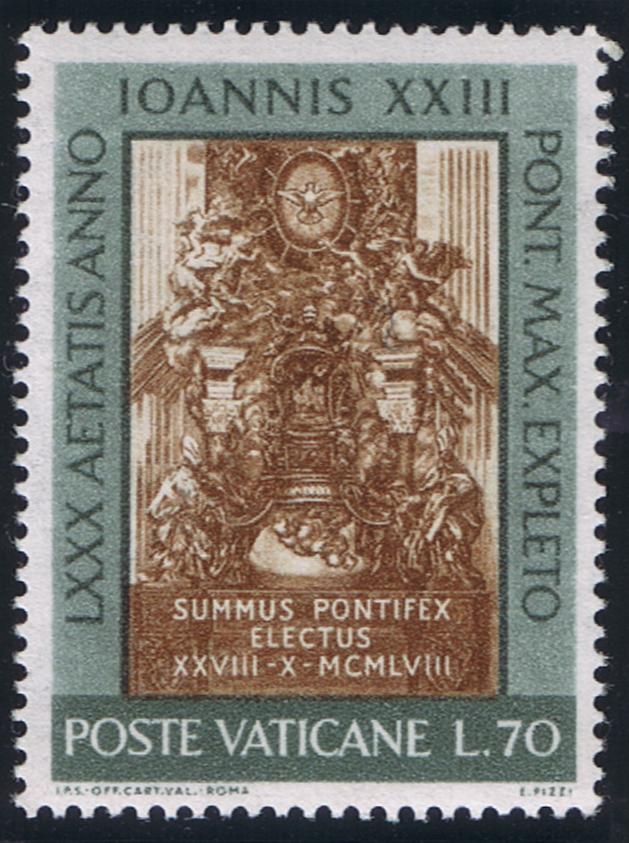 Cathedra Petri Scott 321 (1961) May 2 is celebrated as the feast of Saint Athanasius, one of the 38 Doctors of the Church. There have been no stamps issued by Vatican City specifically honoring this early Christian theologian. In a bit of a stretch, to find him on a stamp, he appears (although not very prominently) on the stamp above, from the 1961 set for the 80th birthday of Pope John XXIII. It pictures Bernini’s magnificent Cathedra of Saint Peter, found in Saint Peter’s Basilica. The monumental work features large statues of four of the early Doctors of the Church. The Western doctors Saint Ambrose and Saint Augustine of Hippo appear on the outsides, wearing miters, and the Eastern doctors Saint John Chrysostom and Saint Athanasius are on the insides, both bare-headed. Here is a photo of the cathedra—he can be seen a bit better in this view: 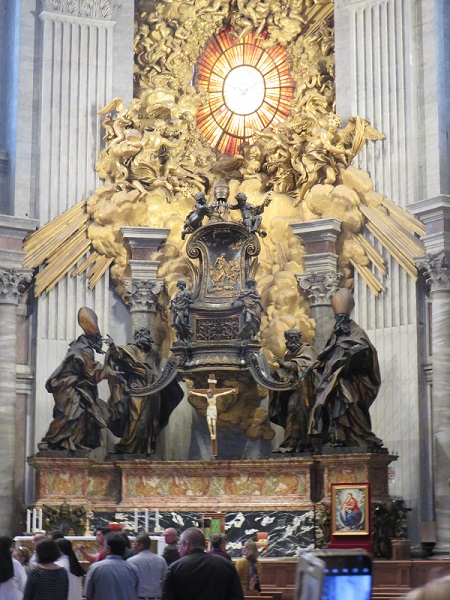 Cathedra Petri, Saint Peter’s Basilica Photo by Marvin Lanahan Used with Permission Athanasius was born around 296 to 298 AD into a Christian family in Alexandria, Egypt. He received a classical education and would go on to enter the priesthood. He became secretary to Alexander, the bishop of Alexandria, and was eventually named bishop himself, succeeding Alexander as the twentieth patriarch of Alexandria. His episcopacy, spanning 45 years from 328 AD until his death on May 2, 373 AD, included periods of exile when he was replaced by four different Roman emperors. Athanasius was a strong proponent of the Trinitarianism, the central Christian doctrine that one God exists as three co-equal, co-eternal, and distinct persons—Father, Son (Jesus Christ), and Holy Spirit—sharing a single divine substance. Like his predecessor, he was an outspoken critic of the heretical movement of Arianism. During this battle against Arianism, following the Council of Tyre in 335 AD, the Roman Emperor Constantine exiled Athanasius to northern Gaul. Following Constantine’s death, he was restored to his bishopric, but this term lasted only a year as he was deposed once again by a coalition of Arian bishops. In total, he would be exiled five times for his defense of the doctrine of Christ’s divinity. During his periods of exile, he traveled and evangelized in a manner reminiscent of Saint Paul.  Saint Athanasius of Alexandria Colonnade, Saint Peter’s Square Photo by Alf van Beem From Wikimedia Commons, used under the terms of the Creative Commons CC0 1.0 Universal Public Domain Dedication During his life, he wrote extensively, promoting Christian theology. In particular, he was greatly devoted to the monastic life, and his ascetical writings include a biography on the life of Saint Anthony the Great, a book which was very popular and contributed greatly to the establishment of monastic life throughout the Western Christian world. Saint Athanasius died on May 2, 373 AD. He is recognized as a saint by all major Christian denominations. He was originally buried in Alexandria, Egypt, but his remains were later transferred to the Chiesa di San Zaccaria in Venice, Italy. Based on his vast contributions and historical writings in support of Christian theology, and his heroic efforts against the heresy of Arianism, Athanasius was raised to the title of “Doctor of the Church” by Pope Pius V in 1568. Along with Saints John Chrysostom, Basil the Great and Gregory of Nazianzus, he is remembered as one of the “Four Great Greek Fathers” of the Church. REFERENCES: |