Home
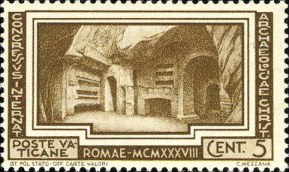

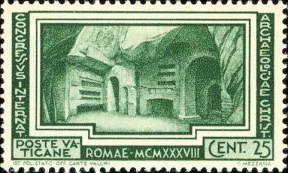 4th International Archaeological Congress: Crypt of Cecilia in Catacombs of Saint Callixtus Scott 55-57 (1938) October 14 is celebrated as the memorial to Pope Saint Callixtus I, an early pope and Christian martyr. Although not specifically honored on stamps issued by Vatican City, he is remembered for his ties to the Roman catacombs, and specifically the catacombs bearing his name. Three of the stamps from the 4th International Archaeological Congress set of 1938, shown above, picture the Crypt of Cecilia found in the Catacombs of Saint Callixtus.  Fresco of Pope Callixtus I Originally found at the Basilica of Saint Paul Outside the Walls From Wikimedia Commons, in the Public Domain Pope Saint Callixtus I (also spelled Callistus, or in Italian San Callisto) was born on an unknown date in the second century. The first accounts of Callixtus recall his life as a slave in Rome. He reportedly mismanaged funds meant for widows and orphans and fled Rome to evade capture. He was caught at sea and was sentenced to forced labor in the salt mines of Sardinia. He was eventually released, along with other Christians, because of amnesty granted by the Roman Emperor Commodus. Callixtus returned to Italy and entered public ministry under Pope Victor I. He would then become a deacon under Pope Zephyrinus. The pope placed Callixtus in charge of the first publicly owned Christian burial grounds, located along the Appian Way and now known as the Catacombs of Callixtus (to be discussed below). Upon the death of Pope Zephyrinus, Callixtus was elected pope as the fifteenth successor to Saint Peter, an election which was fiercely contested by the theologian Hippolytus. Hippolytus would become the first antipope and sat in opposition to the pontificate of Callixtus and three of his successors. His opposition stemmed from his disagreement with the acceptance of converts from sects or schisms back into the Church. Callixtus, on the other hand, declared that the Church had the authority to forgive even the gravest of sins, provided the sinner underwent sincere penance. And, he permitted the readmission of "lapsed" Christians (those who had renounced their faith under imperial persecution) after completing penance. These decisions helped define a papacy guided by an emphasis on mercy and forgiveness. While official details of his death are limited, Pope Callixtus died around the year 222 or 223 AD. Tradition holds that he was killed by an anti-Christian mob and thrown down a well in the Trastevere district of Rome. The Church of San Callisto was built above this site. His body was recovered and initially buried in the nearby Calepodius Cemetery on the Via Aurelia (and not at his own Appian Way catacombs). In the 9th century, his remains were translated to the Basilica of Santa Maria in Trastevere, which is a very short distance from the current Church of Saint Callisto. He is remembered as the patron saint of cemetery workers.  "The Martyrdom of St. Cecilia" by Stefano Maderno (circa 1600) Basilica of Santa Cecilia in Trastevere, Rome Photo by Durski From Wikimedia Commons, used under the terms of the Creative Commons Attribution-Share Alike 4.0 International license The Catacombs of Callixtus, along the Appian Way, established in the third century and initially managed by the future pope, grew into a massive subterranean burial network. It would be the burial site for fifteen popes and an estimated half a million early Roman Christians. Two key areas of the Catacombs stand out. The Crypt of the Popes, sometimes referred to as the "Little Vatican”, contained the remains of nine third-century popes. The Crypt of Saint Cecilia houses the tomb of the saint, whose uncorrupted body was found there in 1599. She is memorialized by the famous sculpture by Stefano Maderno which depicts her body as it was found. Maderno was reportedly present when the body was found, and described the saint as appearing to be simply asleep. Refer to the Vatican Notes article in the References by Greg Pirozzi to take a closer look at the Catacombs of Callixtus. REFERENCES: |