Home

 St. Albertus Magnus: 700th Anniversary of Death Scott 677-678 (1980) The Church celebrates the Feast of Saint Albertus Magnus, or Saint Albert the Great, on November 15. The two-stamp set shown above, issued on November 18, 1980, commemorates the 700th anniversary of his death in 1280. The 300L stamp depicts the saint on horseback on a “mission of peace”, and the 400L stamp shows him holding a book—always the student and teacher. Albert was born into a noble family around the year 1200 in Bavaria. He was educated at Padua in Italy, where he was introduced to the Dominicans and joined their Order. He was then sent back to Germany and spent twenty years as a professor in various religious houses and universities. During this time, he would encounter his most famous student, the Italian Dominican Thomas Aquinas. Albert recognized the intellectual talents of Aquinas and helped nurture and cultivate them. 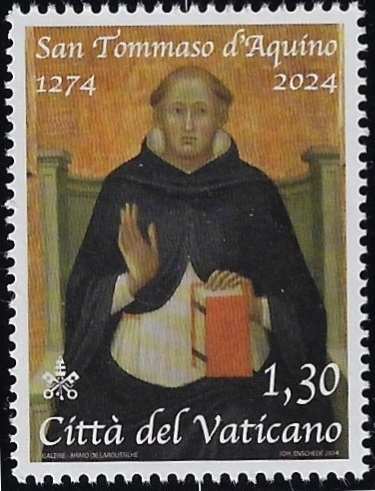 St. Thomas Aquinas: 750th Anniversary of Death Scott 1855 (2024) During this time, Albert was made the prior of a Dominican province in Germany, served as a personal theologian and canonist to the Pope, and preached a Crusade in Germany. He was appointed the Bishop of Regensburg, an unsuccessful assignment that lasted less than two years before he resigned. Following his stint as a diocesan bishop, Albert spent the rest of his life in Cologne centered on his love of learning and teaching. During this time, he also traveled to the Second Council of Lyon in 1274 and to Paris in 1277, where he helped defend Thomas Aquinas from his theological enemies. During his life, Albert the Great’s complete works total thirty-eight volumes on virtually every field of knowledge known at the time: scripture, philosophy, astronomy, physics, mathematics, theology, spirituality, mineralogy, chemistry, zoology, biology, justice, and law. Albert came to greatly admire the work of the Greek philosopher Aristotle. He adapted his approach to philosophical commentary as used by Aristotle, and this was instrumental in the grounding of future Catholic theological research on a foundation “critical thinking”, which was followed by Aquinas and future Catholic intellectuals. It can be said that Albert the Great helped reintroduce Aristotle to the modern Western world. And, Albert’s approach to teaching and the accumulation of knowledge contributed to the establishment of the institutions of learning we now call “universities”.  Peter Lombard: Author of "Four Books of Sentences" Scott 173 (1953) Among his voluminous writings, Albert’s principal theological works include Albert died on November 15, 1280, at the Dominican convent in Cologne, Germany, and his relics are located in the crypt of Saint Andrew's Church in Cologne. Albert was beatified in 1622, and, in 1931, he was canonized and proclaimed a Doctor of the Church by Pope Pius XI. It has been said that, in his time, there was little that Saint Albert did not know or teach. His mastery of all the branches of knowledge was so manifest that he was called “The Great”, and also earning him the title of “Universal Doctor.” REFERENCES: |